
 Eseandre Mordi

⬤ Zyphra has launched ZUNA, a 380 million-parameter model built specifically for electroencephalography data processing. As Brian Roemmele pointed out, the system is available under the Apache 2.0 license, making it freely accessible for research and development.
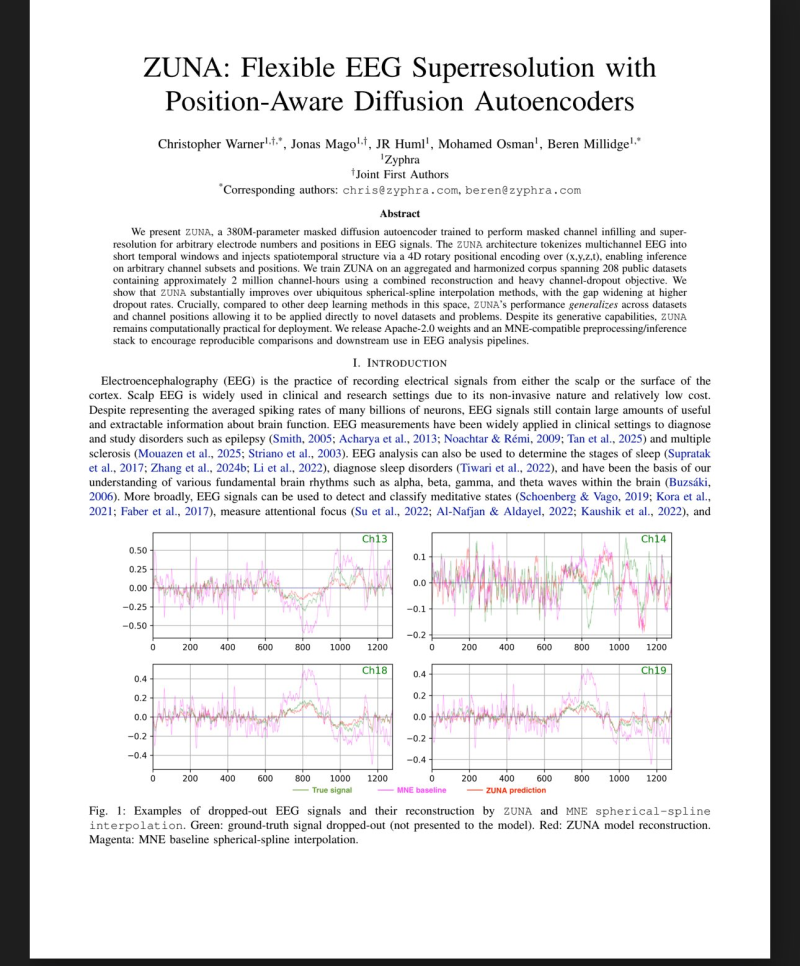
⬤ The model uses a transformer architecture that processes multichannel brain signals through a shared latent space and rebuilds them using a diffusion-based decoder. It was trained on roughly 2 million channel-hours of publicly available EEG recordings. The training approach combines masked channel infilling with heavy dropout techniques, which helps the model denoise signals, fill in missing channels, and predict new ones based on where electrodes sit on the scalp.
According to Brian Roemmele, ZUNA substantially improves over traditional methods, particularly as channel dropout rates increase.
⬤ To handle different electrode setups across studies, Zyphra added some smart design choices. The system breaks EEG data into short time windows and converts them into continuous representations, then uses 4D Rotary Position Embeddings to track both electrode locations and timing. Testing shows ZUNA significantly outperforms traditional spherical spline interpolation, especially when large chunks of data are missing. The performance gap grows wider as more channels drop out, showing the model adapts well across different datasets.

⬤ ZUNA's release adds to the growing wave of open neuro-AI tools and EEG foundation models. By putting a large-scale brain signal model in public hands, Zyphra is opening doors for more people to work on advanced signal reconstruction and pushing forward research in brain-computer interfaces and neural data analysis.
 Eseandre Mordi



