
 Saad Ullah
⬤ Google's Gemini 3.1 Pro Preview claimed the highest position in the Artificial Analysis Intelligence Index while showing impressive efficiency gains over major competitors. The model's combination of strong performance and lower operational costs puts it ahead of both Claude Opus 4.6 and GPT-5.2 (xhigh), marking a turning point in how AI models get judged - not just on raw power, but on practical affordability too.
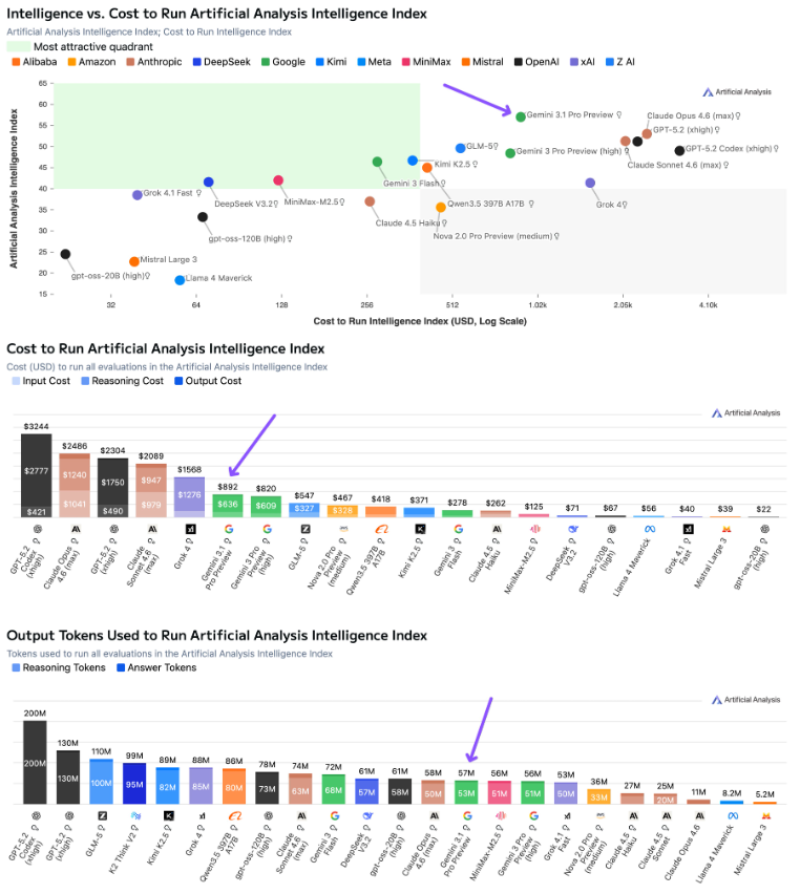
⬤ The pricing breakdown reveals interesting differences. Gemini 3.1 Pro Preview costs $2 per million input tokens and $12 per million output tokens, sitting between Claude Opus 4.6's $5/$25 rate and GPT-5.2's $1.75/$14 rate. But the real story lies in token efficiency. Gemini 3.1 Pro Preview needed just 56 million tokens to finish the index evaluations, while GPT-5.2 burned through 130 million tokens and Claude Opus 4.6 used 58 million. This efficiency translated into a total benchmark cost of only $892 for Gemini, compared to $2,304 for GPT-5.2 and $2,486 for Claude Opus 4.6. That's less than half the cost of either competitor.
⬤ This performance matches up with recent reports showing Google rolls out Gemini 3.1 Pro with 771 ARCAGI2 benchmark score, confirming its competitive strength across multiple evaluation frameworks. Meanwhile, broader ecosystem studies found GPT-5.2 ranking as most restricted among 18 AI models, highlighting different approaches to model deployment.
⬤ The results show that cost-performance balance matters more than ever in AI adoption. When businesses and developers compare options, models that deliver strong results without excessive token consumption could win out in real-world deployments. Gemini 3.1 Pro Preview's efficiency advantage suggests Google may have found a sweet spot between capability and operational economics.
 Saad Ullah



