
 Sergey Diakov
⬤ Nvidia (NVDA) and the semiconductor ecosystem took center stage after a detailed breakdown showed how the entire AI economy builds on one shared industrial foundation. Here's the thing: every AI model—regardless of who built it—sits on the same hardware stack. We're talking chips, data centers, networking, and massive power infrastructure. This isn't just theory—it's the actual "industrial spine" powering everything from ChatGPT to autonomous vehicles.
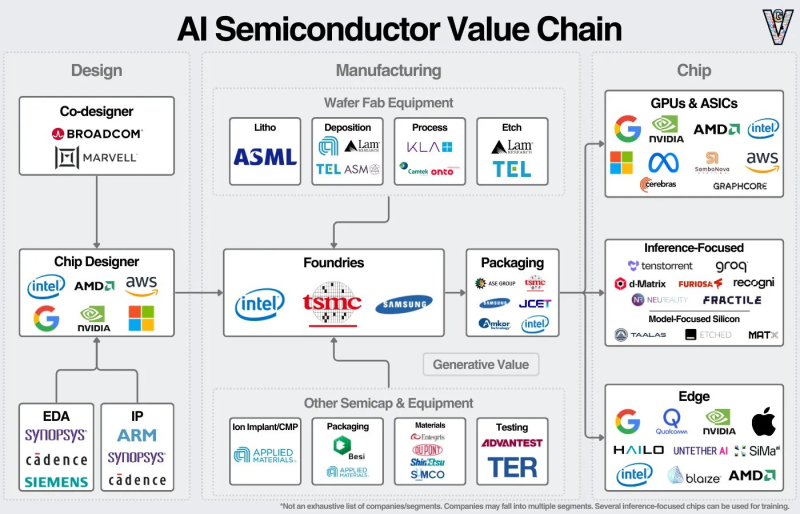
⬤ The real story is in how demand flows through the system. When hyperscalers like Amazon, Microsoft, and Google scale up AI training and inference, that pressure doesn't stop at GPU orders. It cascades downstream—hitting chip designers, foundries, equipment makers, packaging specialists, even memory and networking suppliers. The chart that went viral shows exactly how this works: GPUs and custom accelerators at the top, supported by specialized manufacturing like lithography, etching, deposition, and advanced testing. Each layer feeds the next.
⬤ Hyperscalers are building their own chips, but not for the reason most people think. They're designing custom accelerators mainly to cut inference costs and match AI workloads to their specific infrastructure—not to replace commercial suppliers entirely. So you're seeing a mix: general-purpose GPUs from NVDA, hyperscaler-designed ASICs for internal use, and edge-focused silicon for deployment. All of this relies on EDA tools, IP licensing, foundries, and equipment vendors capable of producing cutting-edge nodes at scale.
⬤ Why this matters: AI growth isn't isolated to one company or chip type. The whole stack is interconnected. Bottlenecks in wafer capacity, packaging availability, equipment supply, or even power infrastructure can slow down the entire system. As global AI adoption accelerates, this dependency is driving capital spending decisions, reshaping supply chains, and setting long-term growth expectations across semiconductors and infrastructure. The value isn't concentrated—it's distributed across every layer that makes AI possible.
 Sergey Diakov



