
 Usman Salis

Mistral AI has introduced Voxtral, a 3-billion-parameter text-to-speech model with open weights, and the early numbers are turning heads. Reported by @kimmonismus, the model goes head-to-head with ElevenLabs Flash v2.5, and according to internal human evaluation data, Voxtral comes out ahead by a notable margin. The release marks another step in Mistral's push beyond language models into voice and multimodal AI.
How Voxtral Stacks Up Against ElevenLabs
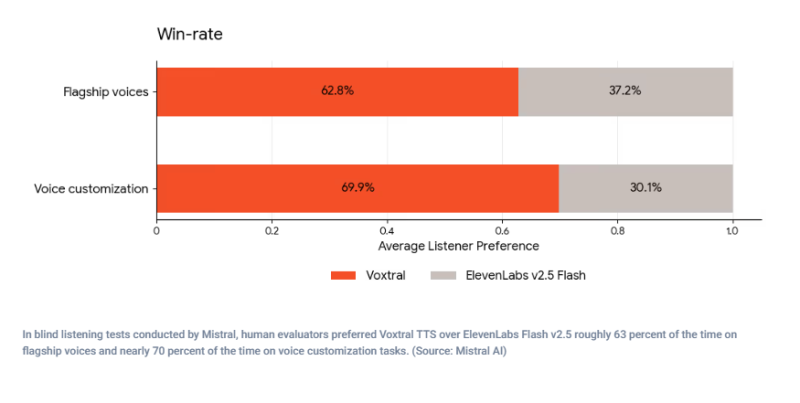
Blind side-by-side evaluations across supported languages had listeners judging naturalness, accent accuracy, and voice similarity. The results: Voxtral achieved a 62.8% win rate on flagship voices and 69.9% on voice customization tasks, beating ElevenLabs Flash v2.5 in both categories. As the company noted, this reflects a "consistent performance gap" under real-world listening conditions.
The model also supports nine languages and can clone a voice from as little as five seconds of reference audio, including cross-lingual adaptation that preserves accent and speech characteristics. This kind of flexibility, paired with strong benchmark results, puts Voxtral in a different league from many closed alternatives.
Voxtral Runs on 3 GB of Memory With 90ms Latency
Efficiency is a key part of the pitch. Voxtral runs on approximately 3 GB of memory and delivers time-to-first-audio latency of around 90 milliseconds, making it a realistic option for real-time applications. The open-weight approach allows developers to deploy and customize the model locally, which is a meaningful contrast to subscription-based systems.
This efficiency focus aligns with broader trends across Mistral's product line. Mistral Small 4 demonstrated similar priorities with its 119B-parameter architecture and a reported 40% speed boost, while the Ministral model family, built with cascade distillation across 3B, 8B, and 14B variants, reinforced the company's commitment to scalable, accessible AI deployment.
The launch signals real movement in the AI voice market. As open models begin to match or exceed proprietary systems in blind tests, the balance between cost, control, and quality is shifting. For enterprise and consumer developers alike, Voxtral's combination of performance, low latency, and local deployment flexibility may prove difficult to ignore.
 Usman Salis



