
 Victoria Bazir

⬤ Researchers at Meta introduced a new approach to improving how large language models analyze software code in a paper titled Agentic Code Reasoning. The study examines whether AI agents can verify code semantics without ever running the program. Rather than relying on pattern recognition or guesses based on function names, the method forces AI systems to trace code line by line using a strict reasoning template. The work comes as Meta expands its AI infrastructure through strategic acquisitions, reflecting the company's deepening commitment to advanced AI systems.
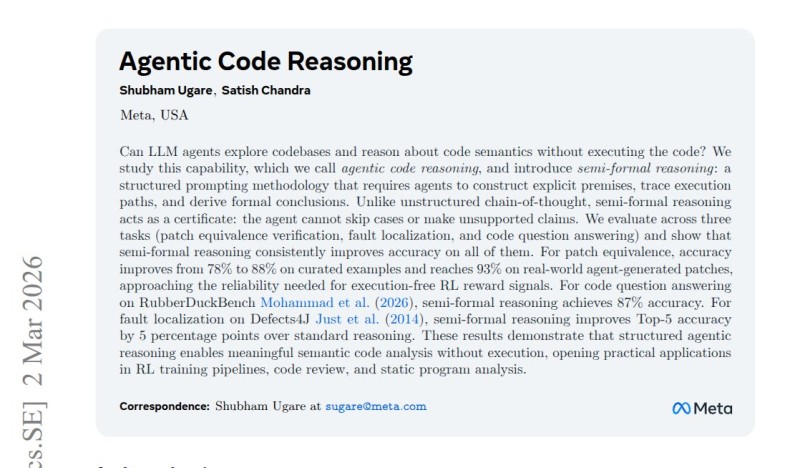
⬤ The technique, called semi-formal reasoning, introduces a structured prompting framework that requires AI agents to build explicit premises, trace execution paths, and arrive at formal conclusions. Unlike conventional chain-of-thought reasoning, the model must provide verifiable evidence for every claim it makes. This creates what researchers describe as a reasoning certificate — a safeguard that prevents the AI from skipping steps or making unsupported assumptions during code analysis. The approach aligns with growing enterprise adoption of autonomous AI agents across organizations seeking more reliable AI-driven workflows.
The model must present verifiable evidence for every claim it makes — effectively creating a reasoning certificate that prevents skipping steps or making unsupported assumptions.
⬤ The results are notable. For patch equivalence verification, accuracy climbed from 78% to 88% on curated datasets and hit 93% on real-world agent-generated patches. Semi-formal reasoning also achieved 87% accuracy on the RubberDuckBench code Q&A dataset and improved Top-5 fault localization by five percentage points on the Defects4J benchmark.
⬤ The findings reflect broader momentum in AI as companies invest in more capable reasoning systems and autonomous software tools. Experiments across the sector increasingly show AI systems performing real-world economic tasks autonomously, pointing to a near future where advanced reasoning models handle complex operational workloads in software engineering.
 Victoria Bazir



