
 Eseandre Mordi
⬤ Google (GOOGL) just made waves with a major breakthrough in autonomous AI learning. The company's Sima 2 framework dropped a Gemini-based agent into a completely new 3D world where it handled everything—proposing tasks, executing them, and evaluating its own results. The AI surpassed human performance through self-improvement iterations, learning entirely from its own generated experiences without any hand-holding.
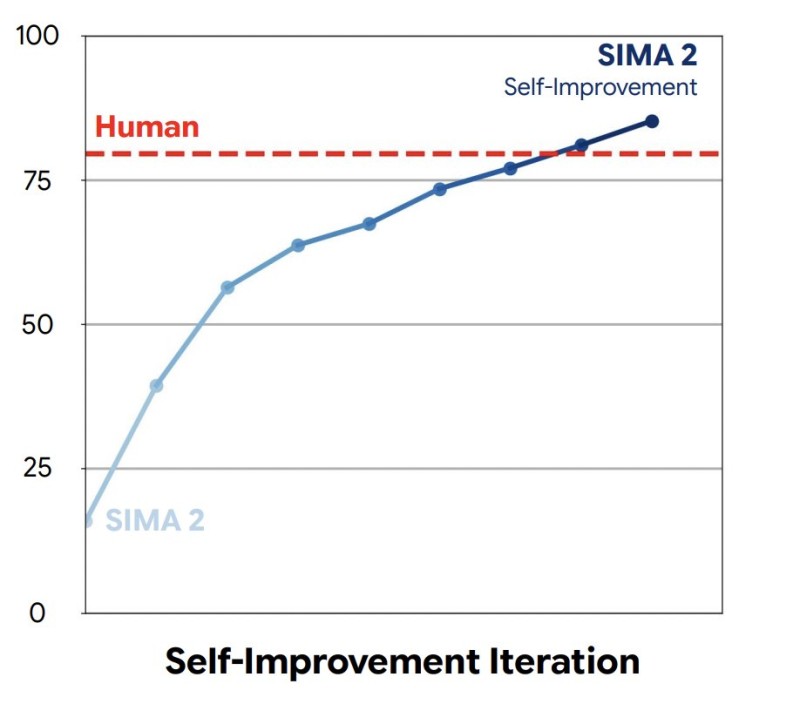
⬤ The performance chart tells the story clearly: Sima 2 started way below the human benchmark but climbed steadily with each iteration. After showing rapid early gains followed by incremental improvements, the model eventually crossed the red human baseline and kept going higher. For GOOGL, this milestone strengthens its position in the race to build autonomous, self-improving AI systems. As AI capability advances continue fueling tech stock enthusiasm, developments around Gemini are pulling serious market attention due to their long-term potential.
⬤ This demonstration fits into the bigger picture of foundational AI research, where companies are pushing toward systems that can handle multitask learning, self-evaluation, and independent skill development. While there's no word yet on immediate commercial applications, watching a model beat human benchmarks through self-directed improvement marks a significant technical achievement for GOOGL. The performance curve shows how repeated cycles let models like Sima 2 refine their behavior and bridge the gap between supervised training and autonomous learning.
⬤ Why this matters: fresh evidence of self-improving AI shifts expectations around how fast capabilities can scale, how competitive the sector's becoming, and where strategic advantages lie in the AI ecosystem. As markets size up the future winners in next-gen model development, breakthroughs from systems like Gemini play a central role in shaping how traders view GOOGL's innovation path.
 Eseandre Mordi



