
 Eseandre Mordi
⬤ Here's the thing about AI computing power right now—it's absolutely exploding. New research from Epoch AI shows that global artificial intelligence computing capacity is doubling approximately every seven months. That's based on quarterly tracking of AI accelerator production across major chip designers. Since 2022, we've seen overall compute capacity expand by roughly 3.3 times per year, which is enabling increasingly massive AI model development and way broader adoption across pretty much every industry you can think of.
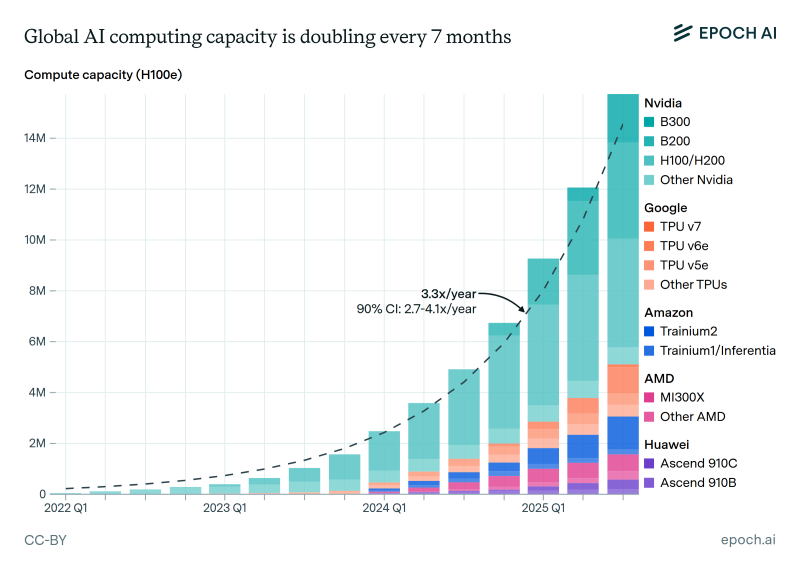
⬤ The chart tracking this growth measures compute capacity in H100-equivalent units, and the curve from early 2022 through early 2025 is seriously steep. What's interesting here is that the data pulls from multiple accelerator platforms, showing that compute growth hasn't plateaued—it's actually accelerated over time. You're seeing contributions from a whole range of providers, including cloud hyperscalers and semiconductor manufacturers, which tells you this is a diversified and rapidly scaling AI hardware ecosystem, not just one or two players dominating.
⬤ According to Epoch AI's modeled trend, global AI compute growth is following a near-exponential trajectory. They estimate an average expansion rate of about 3.3 times per year, with a 90 percent confidence interval ranging from 2.7x to 4.1x annually. The stacked quarterly bars show that capacity additions have been increasing sequentially, which underscores the sustained investment momentum as demand for both training and inference workloads keeps climbing.
⬤ This trend matters for the broader market because compute availability is basically the foundational constraint on AI progress. Faster growth in accelerator capacity means you can support larger models, run more frequent training cycles, and enable wider enterprise deployment. It also intensifies competition across cloud infrastructure and hardware supply chains. As AI compute continues scaling at this pace, it's going to influence technology leadership, capital allocation, and infrastructure planning across the global economy in the years ahead.
 Eseandre Mordi



