
 Saad Ullah
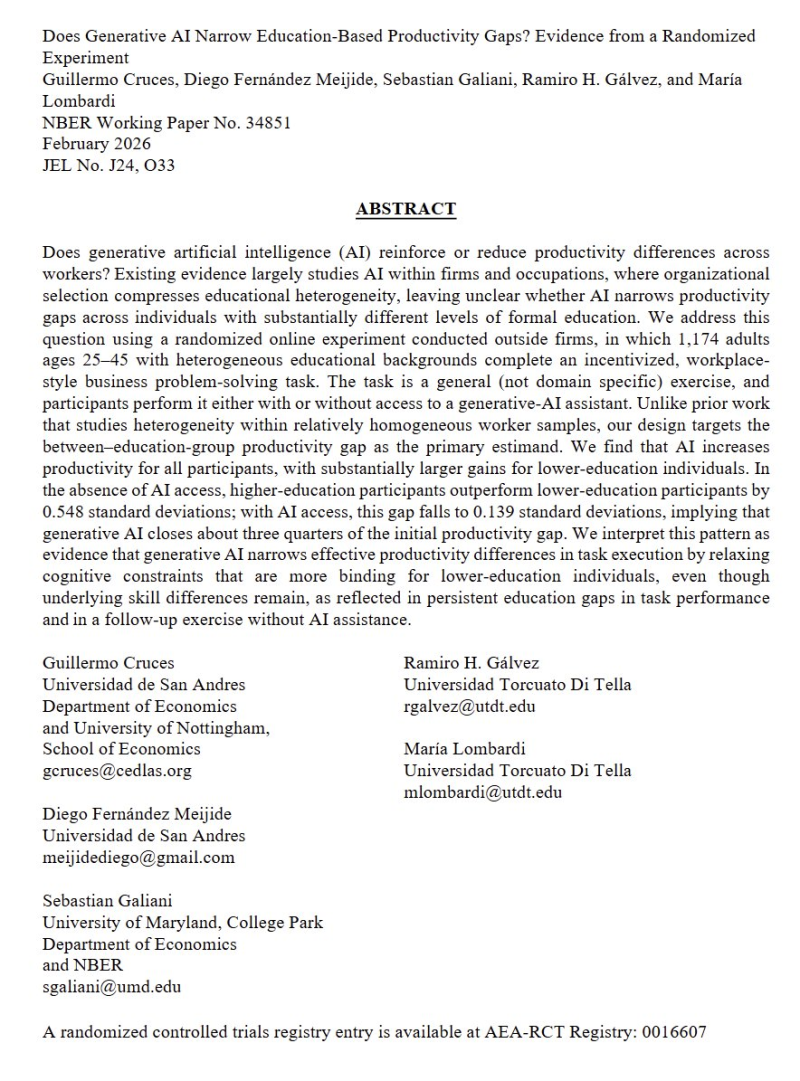
⬤ Researchers from the National Bureau of Economic Research (NBER) ran a randomized experiment to test something a lot of people have been wondering about: can AI actually level the playing field at work? The short answer is yes - and by a surprisingly wide margin. The study found that generative AI reduces the performance gap between more and less educated workers by roughly 75% in a business problem-solving exercise. Participants came from diverse educational backgrounds and completed a workplace-style task either with or without AI assistance.
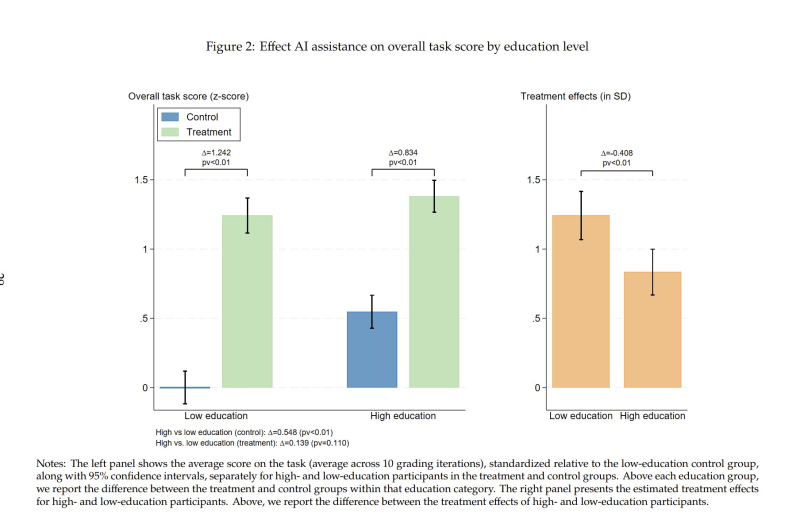
⬤ The numbers are pretty striking. Among 1,174 adults aged 25 to 45 working without AI, higher-educated participants outperformed lower-educated ones by 0.548 standard deviations. With AI in the mix, that gap shrank to just 0.139 standard deviations. In plain terms, AI helped lower-education workers close most of the performance distance - and it did it fast, within a single task. The data in the paper shows green bars (AI group) climbing sharply, especially for participants with less formal education. This is the kind of pattern that's hard to ignore when you're thinking about what AI actually does in the real world, beyond productivity hype. It also connects to broader findings on AI productivity gaps that can show a 38x difference after just one year of diverging usage patterns across the workforce.
Generative AI relaxes cognitive constraints that disproportionately bind individuals with lower formal education.
⬤ The authors argue that AI works here by removing the cognitive bottlenecks that tend to hold back workers without advanced degrees - things like structured reasoning, organizing complex information, and translating ideas into polished outputs. That said, they're careful to note that skill differences don't disappear entirely. In follow-up tasks done without AI, gaps returned. So the tool narrows the divide while it's in use, but doesn't automatically transfer those abilities to the person. That's a real limitation, and one that aligns with concerns raised about AI agents doing the work without sharing it - the 7x skills gap that's still going unsolved.
⬤ What this study adds to the conversation is a concrete, controlled data point. AI isn't just helping the already-skilled get more done - it's giving a meaningful boost to people who've historically been at a disadvantage in knowledge-work settings. As generative AI becomes a standard part of workplace workflows, the implications for hiring, training, and workforce equity are going to be hard to avoid. Whether organizations use that potential thoughtfully is still an open question.
 Saad Ullah



