
 Peter Smith
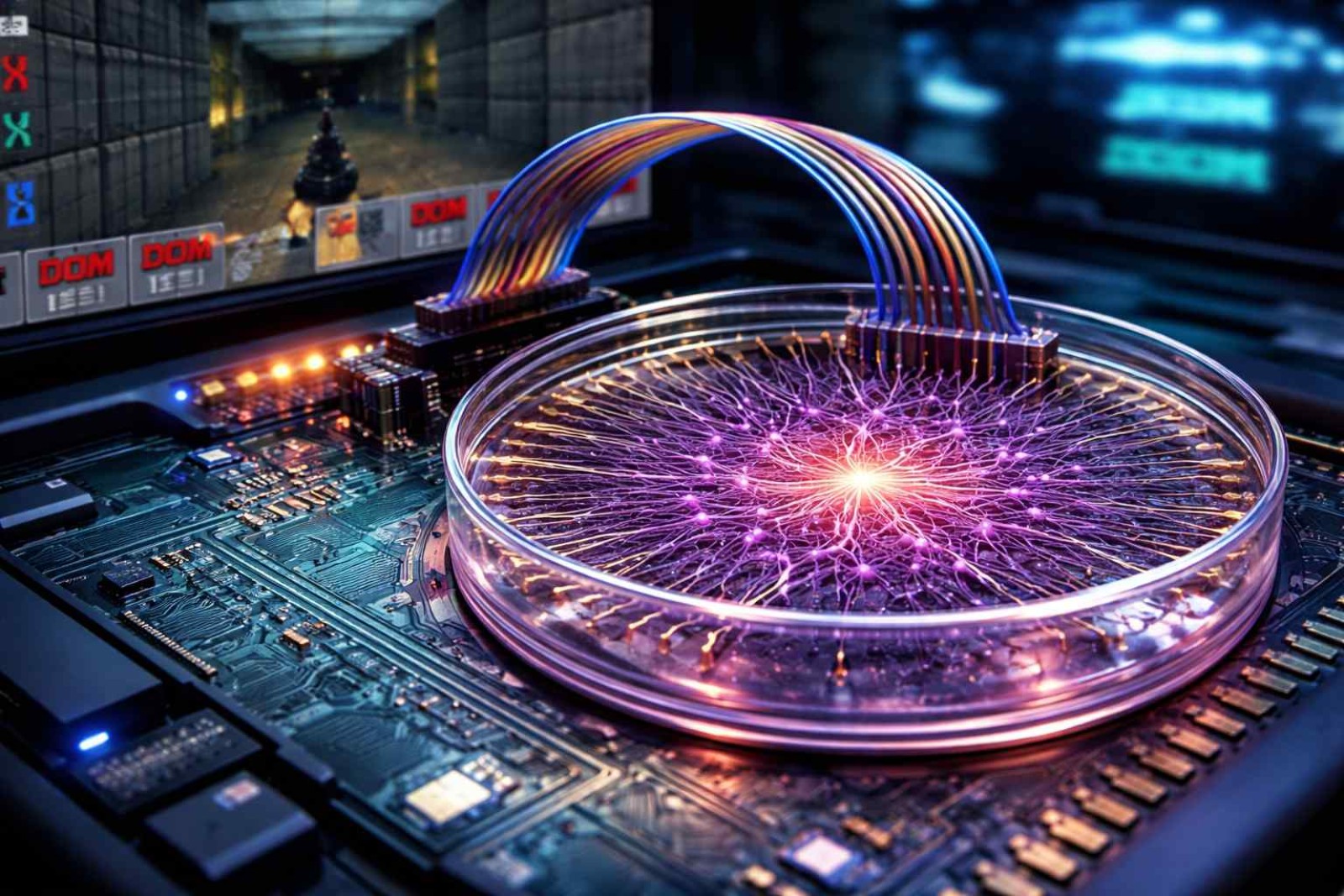
⬤ Australian biotech company Cortical Labs has pulled off something genuinely strange: getting living human brain cells to play DOOM. Researchers grew around 200,000 neurons derived from adult stem cells on a silicon chip inside the company's CL1 biological computer. Rather than sending video to a screen, the system converts game data into electrical signals that stimulate the neurons directly. The project shows how biological neural networks can interface with digital environments and adapt to them in real time, much like Grok Imagine's AI-powered game environment creation.
⬤ The whole thing runs on a feedback loop. When an enemy appears on one side of the screen, the system fires electrical signals to the corresponding region of neurons. Those neurons spike in response, and software decodes those spikes into game actions like moving or shooting. Over time, the cells start reinforcing patterns that lead to better outcomes, a process driven by neuroplasticity rather than conventional training. This mirrors how new AI models are boosting robot intelligence by 716% in scene understanding, reshaping how machines interpret and act on their environment.
Biological neural systems process information through electrical spikes and synaptic connections, which allows them to adapt quickly to sparse or unpredictable inputs.
⬤ This experiment sits within a broader push toward Synthetic Biological Intelligence, where living neurons serve as actual computing components rather than simulated ones. The neurons could navigate game environments, detect enemies, and trigger responses, though performance is still basic compared to conventional software. It is a fundamentally different paradigm from standard AI, which typically needs large datasets and heavy compute cycles to learn. In that sense, it is closer to how a synthetic data engine for embodied AI like Gigaworld-0 tries to mimic real-world learning without massive real-world data.
⬤ Cortical Labs is also building out the infrastructure layer. Through its Cortical Cloud platform, developers can access biological computing hardware remotely via APIs and write code in Python to run on live neuron cultures. These developments point toward a future where computing stretches beyond silicon into hybrid biological-digital systems that learn the way living things do.
 Peter Smith



