
 Usman Salis

The global AI race is tighter than it looks. New benchmark data cited by the Financial Times shows China's large language models narrowing the performance gap with leading US systems at a consistent pace - challenging the assumption that American labs hold a commanding, durable lead.
Between 2024 and early 2026, US models climbed from roughly the low-50s to the low-70s in intelligence ranking scores. Chinese models tracked closely, advancing from the mid-40s to the high-60s.
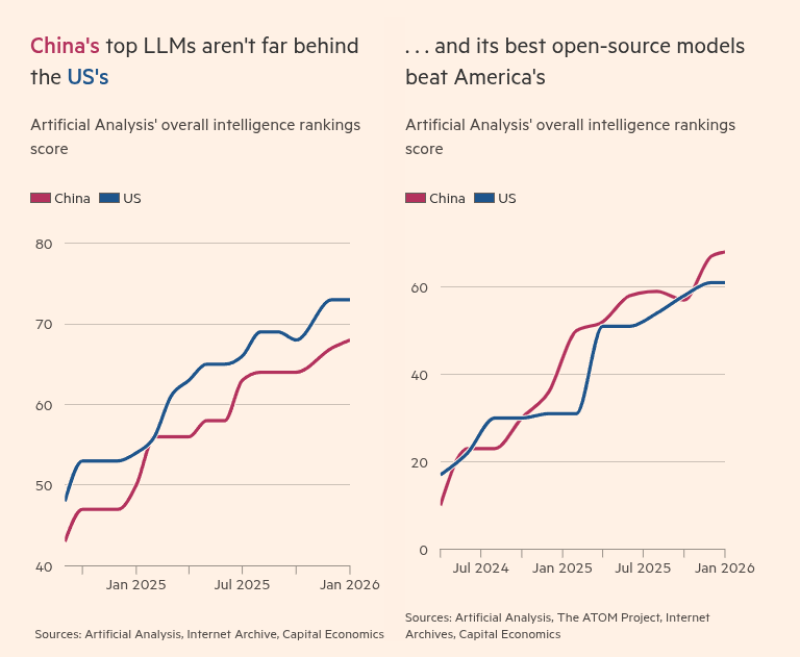
The gap has not closed entirely - US proprietary systems still hold an edge - but the convergence is steady and hard to dismiss. On the open-source side, the US launched Trinity, a large open-source AI model that rivals GLM-4.5 with 80s-range benchmark scores - a sign the competition is intensifying on both sides.
Open-Source Is Where China Already Leads
The more striking story is in open-source. By early 2026, China's top open-source models reached scores in the mid-to-high 60s, pulling slightly ahead of their US counterparts sitting in the low 60s. This matters because open-source models can be freely downloaded, fine-tuned, and deployed without licensing restrictions.
As open-source leadership changes hands, the distribution of AI capabilities becomes more balanced - and more global.
A performance lead here is not just a benchmark win - it is a practical distribution advantage that shapes global adoption at scale.
90% of Humanoid Robots and a Broader Technology Shift
AI model performance is only one part of the picture. China controls 90% of global humanoid robot shipments in 2025, with Unitree leading at over 5,500 units. This hardware-software convergence gives Chinese developers an integrated advantage: AI models trained on real-world robotics data, deployed in environments they help design.
The data points in one direction: AI capability is becoming more distributed. The US retains leadership in closed, top-tier proprietary models - but in the open-source segment where global adoption actually scales, China has moved ahead. Developer tooling is accelerating this shift across regions - illustrated by NanoClaw's Claude-powered AI assistant launch, which gained 350 developer stars within weeks of release. That structural shift in who leads where may prove more consequential than any single benchmark score.
 Usman Salis



