
 Eseandre Mordi

⬤ The United States has officially introduced Trinity Large, an open-source large language model that signals a long-awaited entry into the competitive foundation model space. Trinity Large has been released publicly and is expected to appear on evaluation leaderboards soon. The model is described as broadly comparable to GLM 4.5, placing it alongside established base models rather than experimental research systems.
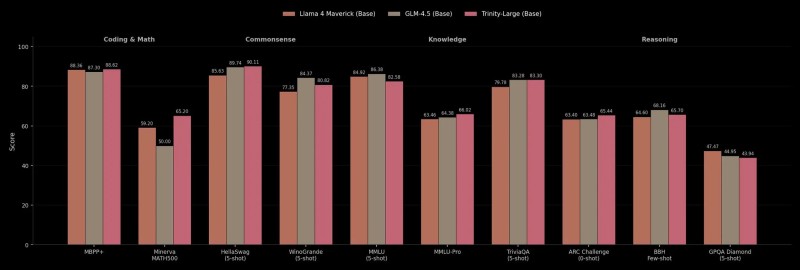
⬤ Benchmark comparisons show Trinity Large stacking up against Llama 4 Maverick and GLM 4.5 across standardized evaluations covering coding, mathematics, commonsense reasoning, factual knowledge, and complex reasoning tasks. In coding and math benchmarks like MBPP+ and Minerva MATH500, Trinity Large posts scores in the high-80s and mid-60s range respectively, closely tracking its peers and occasionally edging ahead. These results show the model meets current baseline expectations for practical programming and quantitative reasoning.
⬤ Across commonsense and knowledge tests—including HellaSwag, WinoGrande, MMLU, and TriviaQA—Trinity Large stays tightly clustered with comparison models. Scores generally land in the low-to-mid 80s for commonsense tasks and mid-60s to low-80s for knowledge benchmarks, reflecting consistent performance rather than sharp specialization. More demanding reasoning evaluations like ARC Challenge, BBH, and GPQA Diamond also show Trinity Large performing within a narrow band relative to Llama 4 Maverick and GLM 4.5, reinforcing its positioning as a competitive general-purpose base model.

⬤ The release matters because it represents a strategic shift rather than just a performance milestone. An open-source U.S. foundation model at this level broadens access to advanced capabilities, supports domestic research and deployment, and increases competitive pressure in a field dominated by a handful of global players. As Trinity Large gets added to public leaderboards and adopted by developers, its presence could influence expectations around openness, benchmarking transparency, and long-term model development strategies.
 Eseandre Mordi



