
 Peter Smith

⬤ Researchers from Shanghai AI Lab, Shanghai Jiao Tong University, Fudan University, Renmin University of China, and Tongji University have introduced a framework for explaining extreme "Black Swan" events in complex multi-agent AI systems. The team adapted the Shapley value method to analyze these rare but high-impact occurrences, determining when they originate, which agents contribute most, and what behaviors AI Systems Are Learning to Act, Not Just Predict amplify the risk across interconnected networks.
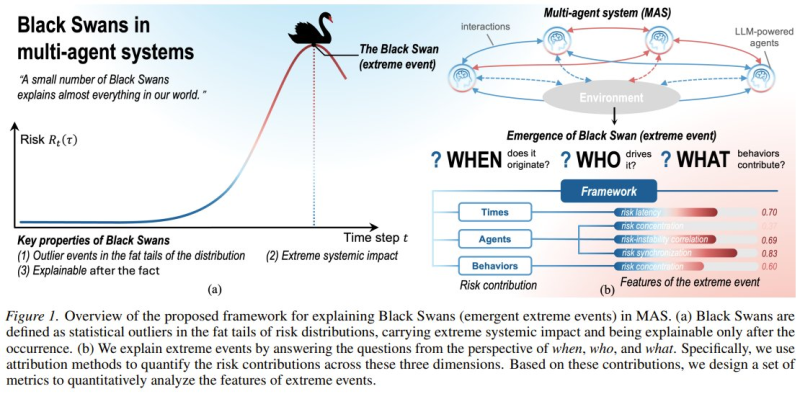
⬤ The framework defines Black Swan events as statistical outliers sitting in the fat tails of risk distributions, capable of producing significant systemic impact. Multi-agent systems consist of several LLM-powered agents interacting with one another while responding to a shared environment. Over time, these interactions accumulate risk until an extreme event surfaces. The model highlights that such events often become explainable only after they occur, reflecting the layered complexity of advanced AI architectures.
Such events often become fully explainable only after they occur, reflecting the complex dynamics present in advanced AI systems.
⬤ To map these dynamics, the researchers built a structured approach around three dimensions: time, agents, and behaviors. The framework answers three core questions about any extreme event: when it begins, who drives it, and what behaviors fuel its development. Four measurable indicators track risk buildup: risk latency, risk instability correlation, risk synchronization, and risk concentration. Quantifying these factors allows the model to attribute how different agents and interactions contribute to extreme outcomes in large networks.
⬤ The study reflects a broader shift in AI toward systems built from multiple interacting agents rather than standalone models. As AI moves beyond prediction into complex actions and task coordination, understanding agent interaction dynamics has become a critical research area. Parallel developments in autonomous capabilities are explored in AI System Generates $10,000 in 7 Hours Through Real Work Tasks, illustrating how rapidly evolving AI technologies are reshaping the role of autonomous digital agents in real-world environments.
 Peter Smith



