
 Peter Smith
As AI workloads keep pushing hardware to its limits, a new framework from the University of Minnesota called StitchCUDA is promising to take the pain out of GPU optimization. The system uses multiple AI agents working in tandem to write and tune CUDA programs automatically, targeting the kind of low-level performance work that typically demands deep specialist knowledge.
Three-Agent Pipeline: Planner, Coder, and Verifier
StitchCUDA is built around three specialized roles. The Planner profiles existing GPU code using dedicated analysis tools to locate bottlenecks and break the work into structured subtasks.
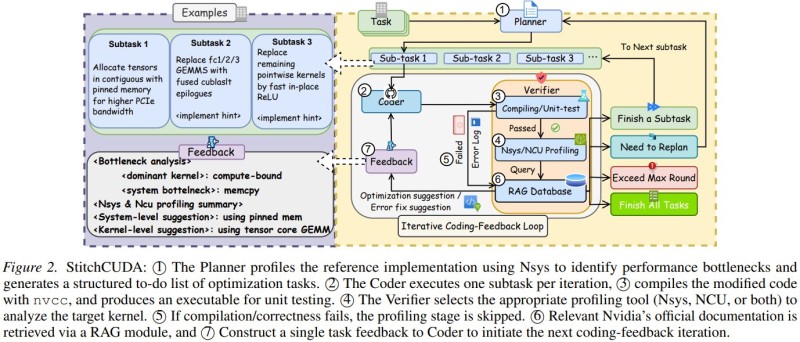
The Coder then modifies CUDA kernels, applying techniques like kernel fusion and memory optimization to address each identified issue. Finally, the Verifier compiles the updated code, runs unit tests, and checks profiling results to confirm whether the changes actually helped. The broader push for efficient GPU utilization connects directly to hardware-level innovations like Nvidia's NVFP4, which trains a 12B-parameter model 2.3x faster using 4-bit precision.
Benchmark Results: 1.72x Faster Than Multi-Agent Baselines
What sets the system apart is its iterative feedback loop. When a modification fails to compile or misses a performance target, the framework pulls in relevant documentation and feeds that context back to the Coder for the next attempt. The Coder itself is trained using rubric-based reinforcement learning, allowing it to absorb advanced CUDA techniques from real execution outcomes. As AI systems grow more capable, understanding how failures cascade matters too -- a point addressed in the 4-Dimensional Framework that Cracks the Code on AI Black Swan Events.
On end-to-end GPU programming benchmarks, StitchCUDA reported a near-perfect success rate and delivered a 1.72x speedup over competing multi-agent systems. Compared to reinforcement-learning-only models, the improvement reached 2.73x -- significant margins where incremental throughput gains translate directly to cost savings at scale. GPU shortages remain a persistent constraint across the industry, and creative responses keep emerging, including Bit Origin's approach to merging AI computing with mining to ease GPU shortages. StitchCUDA positions automated optimization as one more lever in that toolbox -- one that works at the programming level rather than the supply chain.
 Peter Smith



