
 Saad Ullah
⬤ China produced roughly 1,193 terawatt-hours (TWh) of solar electricity in 2025, claiming 43.1% of the world's total 2,771 TWh. That's 3.1 times more than the United States, which logged 387 TWh for the year. This solar dominance fits into a broader story of energy expansion covered in China's Electricity Generation Jumps 7.4% as US Faces AI Power Challenge, where grid-scale growth continues to outpace most Western benchmarks.
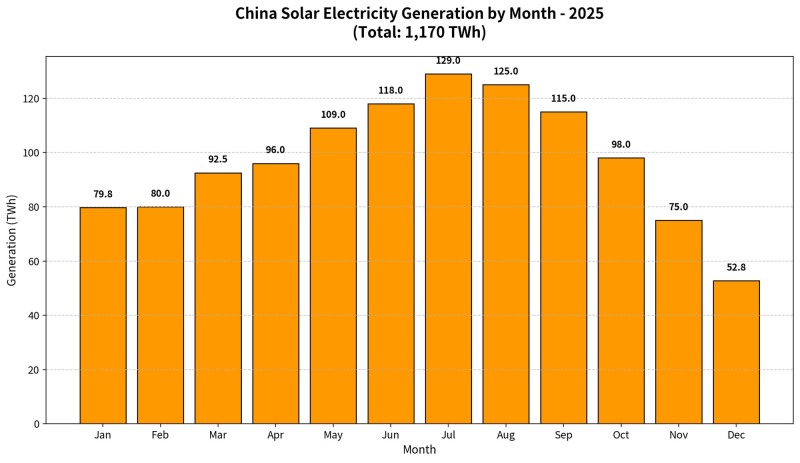
⬤ Monthly output data tells its own story. Generation started at 79.8 TWh in January, climbed steadily, and peaked at 129.0 TWh in July. Production held above 100 TWh from May through September before dropping to 52.8 TWh in December - a seasonal curve that reflects the natural rhythm of photovoltaic output. Token-scale dominance is emerging in AI too, as seen with MiniMax M25 Tops Token Chart With 30.7 Trillion Generated, Passing Claude Opus 4.6, where a single player claimed the top spot across the entire benchmark chart.
China's solar generation is nearly equal to the combined production of all other countries
⬤ All remaining nations together contributed 1,578 TWh - only slightly more than China alone. This kind of market concentration isn't unique to energy. Nintendo Switch Hits 155.37 Million Units, Becomes Nintendo's Bestselling Console Ever is another example of how a single product can reshape an entire industry's competitive landscape when scale compounds over time.
⬤ For solar energy, China's scale carries real downstream weight. Supply chains, panel pricing, grid technology standards, and international infrastructure investment are all shaped by what happens inside one country's energy build-out. As that build-out keeps expanding, its influence on the global energy transition isn't just significant - it's structural.
 Saad Ullah



