
 Peter Smith

⬤ Amazon Web Services has published updated guidance explaining how its three load balancers—Application Load Balancer (ALB), Network Load Balancer (NLB), and Gateway Load Balancer (GLB)—each serve distinct infrastructure requirements. Teams often treat these services interchangeably, but AWS warns that selecting the wrong type can trigger latency problems, routing complications, and unnecessary costs in production environments.
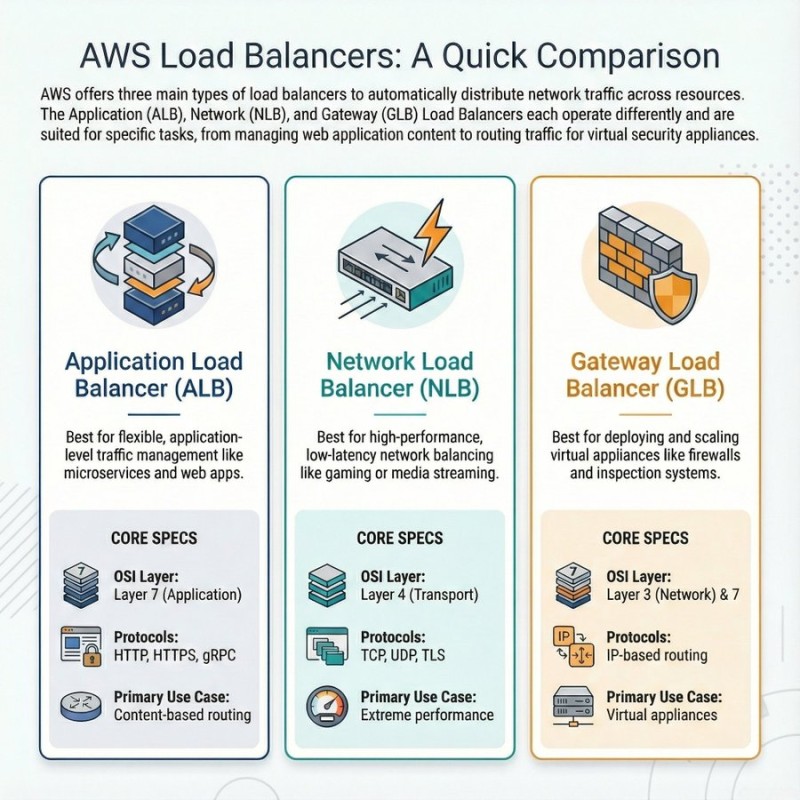
⬤ The ALB handles Layer 7 traffic and excels at application-level tasks like HTTP, HTTPS, and gRPC routing. It's built for content-based decisions, path matching, and microservice architectures. The NLB works at Layer 4, prioritizing raw speed over packet inspection to deliver ultra-low latency and consistent throughput—ideal for gaming servers, live streaming, and transport-layer workloads. The GLB targets virtual appliances like firewalls and security inspection tools, using IP-based routing that supports both Layer 3 and Layer 7 functions, letting companies scale security infrastructure without physical hardware.
⬤ Each load balancer involves specific trade-offs. ALB provides sophisticated routing but requires more processing power. NLB delivers maximum performance but doesn't analyze protocols beyond the transport layer. GLB enables scalable deployment of virtual security tools through predictable IP handling. Understanding these differences helps teams prevent performance bottlenecks and optimize resource use across AWS deployments.
⬤ Amazon's focus on proper load balancer selection reflects the rising complexity of cloud infrastructure. As companies run more microservices, real-time systems, and virtualized security layers, the choice between ALB, NLB, and GLB directly impacts reliability, response times, and overall costs within AWS environments.
 Peter Smith



