Peter Smith

⬤ Alibaba Group and Beijing University of Posts and Telecommunications have unveiled SpatialGenEval, a new benchmark designed to measure spatial reasoning in text-to-image AI systems. The framework addresses a recurring limitation in image generation - even advanced models struggle to place objects precisely within complex layouts. SpatialGenEval replaces simple keyword prompts with dense descriptions involving object relationships, occlusion, motion, and physical interactions to better reflect real-world visual reasoning challenges. The initiative reflects broader momentum in China's AI ecosystem, as highlighted in Alibaba leads open-source AI with 5000 monthly derivative models as Chinese platforms dominate.
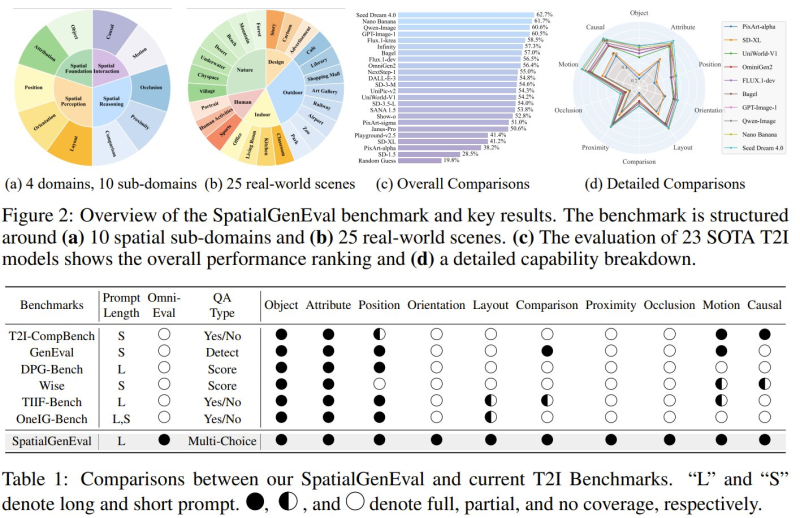
⬤ The benchmark spans four spatial domains, ten sub-domains, and 25 real-world scenes. According to the overview figure, 23 state-of-the-art text-to-image models were evaluated, producing both overall rankings and detailed capability breakdowns. The results reveal spatial bottlenecks across positioning, layout composition, comparison, proximity, and causal reasoning. Fine-tuning on the new dataset improved performance by up to 5.7% for models such as Stable Diffusion-XL and OmniGen. "Our findings show that spatial reasoning isn't just a prompt problem - it's a fundamental training gap," researchers noted. These findings emerge amid rapid model optimization cycles, including smaller yet competitive systems like Tiny AI model Nanbeige413B achieves 874 score outperforms 32B systems.
⬤ The study suggests that spatial reasoning remains a structural limitation rather than a superficial prompt-engineering issue. Even top-tier systems exhibit weaknesses when tasked with dense layout instructions. Improvements appear achievable through dataset-level refinement rather than entirely new architectures, pointing to training data composition as a critical factor. The introduction of SpatialGenEval comes at a time of broader strategic shifts in AI infrastructure and policy. Industry reports such as China tightens restrictions as Beijing pushes shift from Nvidia chips illustrate how hardware and regulatory factors intersect with software innovation. As generative AI expands into design, robotics, and industrial visualization, benchmarks that rigorously test spatial intelligence may play an increasing role in defining competitive differentiation across models and regions.
 Peter Smith