Victoria Bazir

A research framework called SpecEyes is drawing attention for solving one of the most persistent problems in modern AI systems: sequential slowdowns that make agent-based models expensive and sluggish. As Multi-agent AI systems outperform single models has shown, the architecture of how AI agents collaborate directly shapes their performance ceiling - and SpecEyes is taking direct aim at that constraint.
How SpecEyes Breaks the Sequential Bottleneck
Most agentic AI pipelines work like a chain: each step waits for the previous one to finish before moving forward. That design creates predictable latency and drives up compute costs as systems scale. SpecEyes replaces part of that chain with a stateless parallel stage, where a lightweight model predicts execution trajectories in advance - a technique called speculative perception and planning.
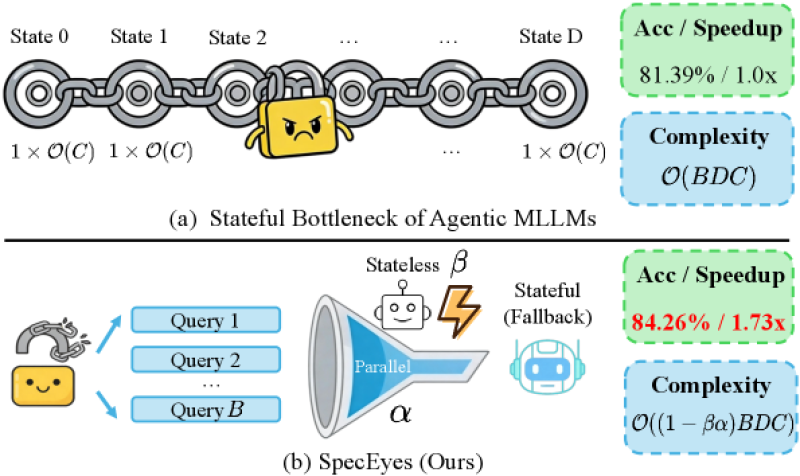
The result is that multiple queries can be processed at the same time, before the system falls back to a stateful path only when needed. It's a practical application of the same parallelization principles that have already reshaped how data pipelines and distributed systems are built.
Speed and Accuracy Gains Across Benchmarks
The numbers back up the approach. SpecEyes achieves speedups ranging from 1.1x to 3.35x depending on the task, while benchmark accuracy actually improves - climbing from 81.39% to 84.26%.
Computational complexity drops from O(BDC) to O((1-ba)BDC), which is a meaningful reduction in overhead for systems running at scale. As AI job growth surges after ChatGPT adoption illustrates, faster and cheaper AI isn't just a research metric - it has direct consequences for how broadly these tools get deployed.
Why This Architecture Direction Matters
Latency and cost are real deployment barriers, particularly in industries where AI systems need to run continuously or respond in near real-time.
The fact that SpecEyes improves both speed and accuracy simultaneously - rather than trading one for the other - makes it a credible step forward. For context on what these systems are already capable of, AI systems show early signs of deceptive behavior is a useful read on the broader frontier being navigated.
 Victoria Bazir