
 Usman Salis

⬤ A 3-billion-parameter model just embarrassed some of the biggest names in AI. Nanbeige4.1-3B is turning heads after benchmark tests showed it beating models with over 30 billion parameters across everything from code generation to complex reasoning tasks. The results are striking when you look at the numbers - this compact system is punching way above its weight class against various Qwen3 models that dwarf it in size. It's part of a bigger pattern we're seeing where smart architecture beats brute force, similar to what happened when tiny AI model Nanbeige413B achieves 874 score, outperforms 32B systems.
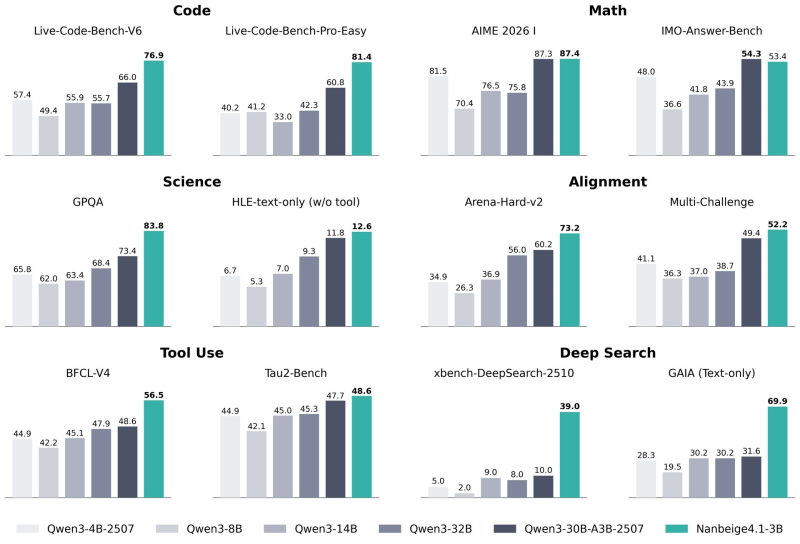
⬤ The coding benchmarks tell the story clearly. On Live-Code-Bench-V6, Nanbeige4.1-3B scored 76.9, and pushed that to 81.4 on the Pro-Easy version - both leading results against larger competitors. Math performance was equally impressive, with an 87.4 on AIME 2026 I and 53.4 on IMO-Answer-Bench. The model didn't just excel in one area either. It delivered strong scores across science tasks (GPQA) and alignment tests like Arena-Hard-v2 and Multi-Challenge, showing it's genuinely well-rounded rather than overtrained for specific benchmarks. These gains mirror competitive shifts we saw when Claude Opus 4.6 leads Swerebench with 517 score as Qwen3CoderNext reaches 40.
⬤ Tool use is where things get really interesting. The model hit 56.5 on BFCL-V4 and 39.0 on xbench-DeepSearch-2510, while managing 69.9 on GAIA's text-only tasks. Here's what stands out: it can handle up to 600 tool-call turns, which means it's capable of genuinely complex, multi-step reasoning sequences. That's starting to look like actual agentic behavior. Of course, as these systems get more capable, security concerns grow too - something highlighted by recent incidents like AI-powered malware hits blockchain developers in 3 countries.
⬤ What Nanbeige4.1-3B really shows is that the AI development game is changing. Smart design and architectural refinement can now compete with models ten times larger. As open-source AI matures and benchmarks get more competitive, these efficient cross-domain performers are reshaping the landscape.
 Usman Salis



