
 Eseandre Mordi
⬤ A radar chart comparing GPT-5 and GPT-4 has gone viral, reigniting fierce debates about how close we really are to artificial general intelligence. The visual breakdown shows just how fast large language models are evolving, and it's pretty eye-opening. The comparison backs up what many experts are already saying: modern AI systems are now crushing human professionals at language and math tasks. Instead of showing narrow improvements in one or two areas, the chart positions GPT-5 as a massive leap forward across the board.
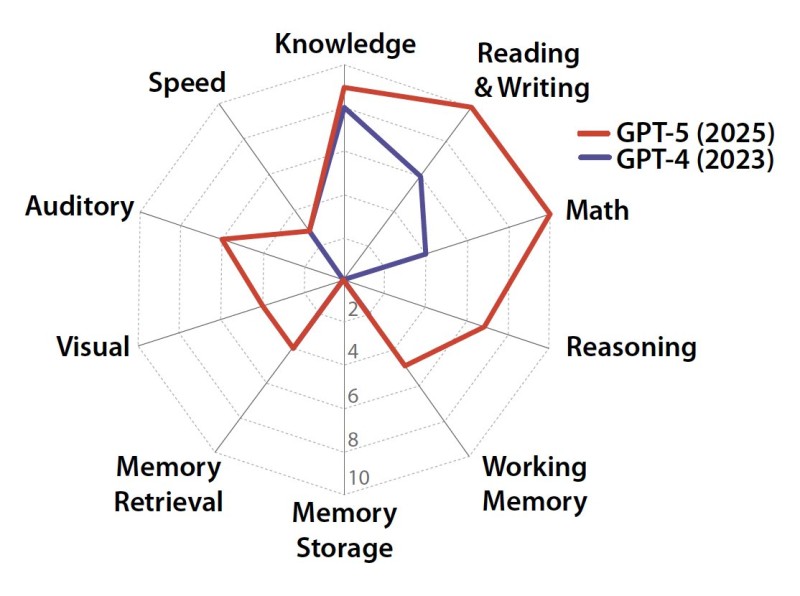
⬤ Here's what the chart actually measures: GPT-5 (2025) versus GPT-4 (2023) across ten different cognitive abilities—knowledge, reading and writing, math, reasoning, working memory, memory storage, memory retrieval, visual processing, auditory processing, and speed. GPT-5 absolutely dominates in the language and analytical zones: reading, writing, math, and reasoning all show huge gains. These happen to be the exact skills that define professional knowledge work, which reinforces the argument that AI has already left typical human experts in the dust when it comes to structured thinking.
⬤ But it's not all smooth sailing. The chart also exposes where progress has stalled. Memory functions—especially long-term storage and retrieval—are still pretty limited, even in GPT-5. Visual and auditory processing show some improvement, but nothing compared to the jumps in abstract reasoning and language. This lopsided development perfectly captures the core challenge: boosting raw intelligence is getting easier, but making AI truly general and well-rounded across every domain? That's still the hard part.
⬤ The bigger picture here is a shift in how we're talking about AI progress. The conversation isn't really about whether language models can match human performance anymore—it's about how fast they can become genuinely versatile and adaptable. The GPT-5 versus GPT-4 comparison suggests we've moved past the phase of chasing human-level benchmarks in isolated tasks. Now it's all about integration: taking those specialized strengths and building systems that can actually operate flexibly across different contexts. This puts the race to general intelligence front and center, with each new model generation closing the gap between being really good at specific things and being capable of, well, everything.
 Eseandre Mordi



