
 Saad Ullah
⬤ Analysis cited by Citadel Securities argues that generative AI adoption is unlikely to sustain unlimited exponential growth. Instead, it will probably trace a familiar S-curve, much like personal computers and the internet before it. Early acceleration is real, but economic and physical constraints will eventually set the pace. A comparison chart included in the research shows PC adoption climbing from roughly 20% to nearly 70% of working-age adults, while internet penetration pushed toward 90% in some markets before leveling off.
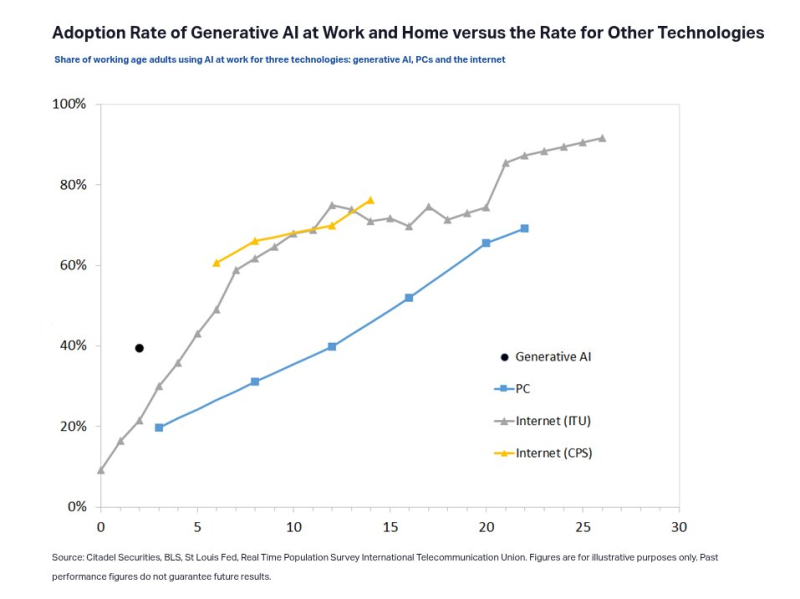
⬤ Generative AI appears to be entering that same early steep climb. Global enthusiasm is wide - trends covered in China leads global AI adoption with a 60% enthusiasm gap over major economies show how fast the technology is spreading beyond the U.S. The pattern tracks: rapid early uptake, mainstream normalization, then a gradual plateau as the market matures and novelty fades.
Even if algorithms keep improving, global deployment still depends on physical capital compute infrastructure and electricity supply.
⬤ Infrastructure is the real bottleneck. Scaling AI across industries demands specialized chips, large data centers, and enormous energy resources. As automation spreads, demand for compute could surge - pushing up marginal operating costs. At that inflection point, the economic incentive to replace human labor starts to shrink. Meanwhile, model capabilities keep advancing fast: Claude Opus 4.6 tops benchmarks as capability doubling time drops to 4 months, showing how quickly the technology evolves even as physical constraints remain fixed.
⬤ The research concludes that generative AI will likely plateau once operating costs approach the cost of human labor in a given task. New commercial infrastructure models like those behind Xiaomi MiMo's 0.101M token recharge system ahead of API billing reflect how the industry is already adapting pricing to manage those cost pressures. The S-curve, in other words, is not a pessimistic scenario. It is simply history repeating.
 Saad Ullah



