
 Artem Voloskovets

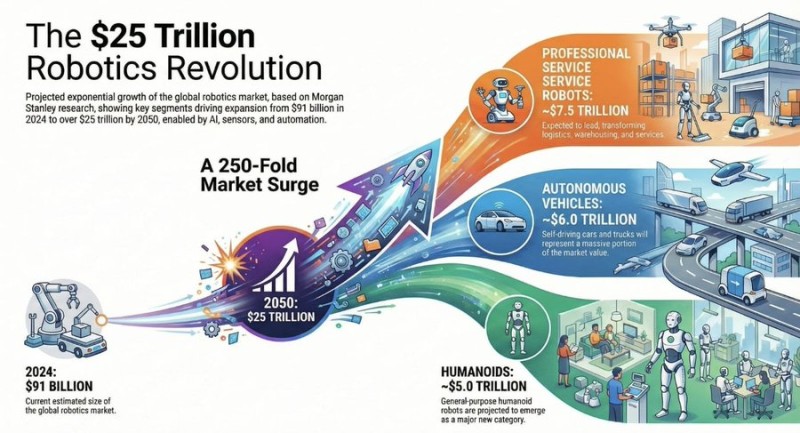
⬤ The robotics market stands on the brink of explosive growth, with projections showing expansion from $91 billion today to $25 trillion by 2050. This transformation stems from rapid automation adoption across multiple industries. Since 2015, the sector has maintained a steady 13% annual growth rate, with momentum building in logistics, agriculture, and healthcare.
⬤ Logistics automation leads the charge with capital spending jumping over 20% yearly. Robot-equipped warehouses see productivity gains of 25-30%, proving the real-world impact of automation. Amazon exemplifies this shift, operating more than 1 million robots across 300+ facilities worldwide.
⬤ Agricultural robotics will expand from $17.73 billion in 2025 to $56.26 billion by 2030—a 26% annual growth rate. Healthcare robotics show similar promise, with surgical robots growing from $13.69 billion to $27.14 billion by 2030. England's NHS plans to perform 500,000 robotic surgeries annually by 2035, up from roughly 70,000 in 2025.
⬤ This technological shift promises fundamental changes to global markets. Industries will see sharper productivity, lower costs, and fresh innovations as automation scales. The move from $91 billion to $25 trillion represents more than numbers—it signals a new era of technology-driven economies where robots become standard rather than exceptional.
 Artem Voloskovets



