
 Marina Lyubimova
⬤ xAI just launched a Batch API for Grok, and it's a clear play for enterprise customers who need serious scale. Instead of hitting the API in real time and burning through rate limits, you can now queue up inference requests and let them process in the background. This is built for teams running big, non-urgent workloads—stuff like analyzing mountains of text, generating embeddings, or churning through documents without clogging up your live applications.
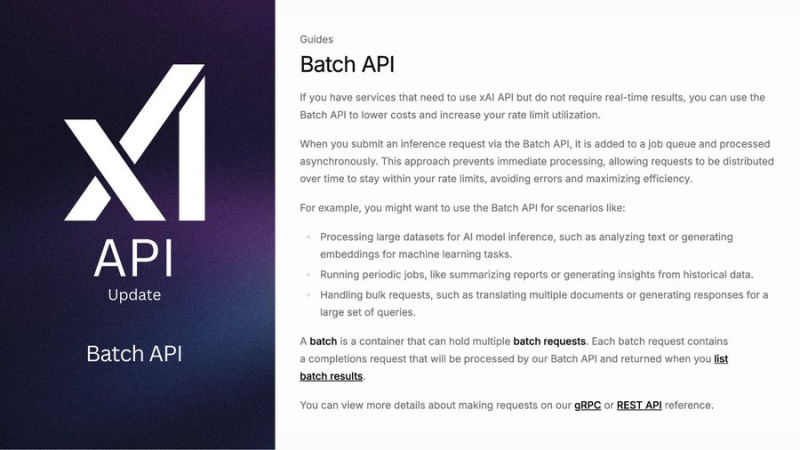
⬤ Here's what makes it useful: each batch handles up to 25MB of data, and the system processes everything asynchronously so you're not bottlenecked by immediate demand. You stay within rate limits, costs drop, and your infrastructure doesn't take a hit from massive spikes. The documentation lays it out clearly—queue your requests, let Grok handle the processing over time, and pull results when they're ready. It's designed for teams that need predictable, efficient AI processing without the chaos of real-time load management.
⬤ The tooling is solid too. Full SDK control means you can create batches, monitor status, cancel jobs, and paginate through results without jumping through hoops. Run multiple batches at once with stable throttling, coordinate across projects, and schedule periodic jobs like summarizing archives or processing document backlogs. It's the kind of infrastructure that matters when you're moving beyond demos into actual production environments.
⬤ This launch signals where the AI arms race is heading—it's not just about who has the fastest model anymore. Enterprises care about efficiency, scalability, and predictable costs at volume. xAI is betting that developers want tools that handle real-world deployment challenges, not just flashy benchmarks. As more companies push AI workloads into production, features like batch processing and cost optimization are becoming table stakes. Grok's Batch API puts xAI squarely in that conversation.
 Marina Lyubimova



