
 Alex Dudov
⬤ Weaviate has teamed up with CrewAI to show how production-ready agentic AI systems actually work. The key difference between basic ChatGPT wrappers and real enterprise AI isn't just adding more features—it's about building systems that can scale reliably. Their blueprint shows multiple specialized agents working together through a central orchestration layer instead of dumping everything on one model.
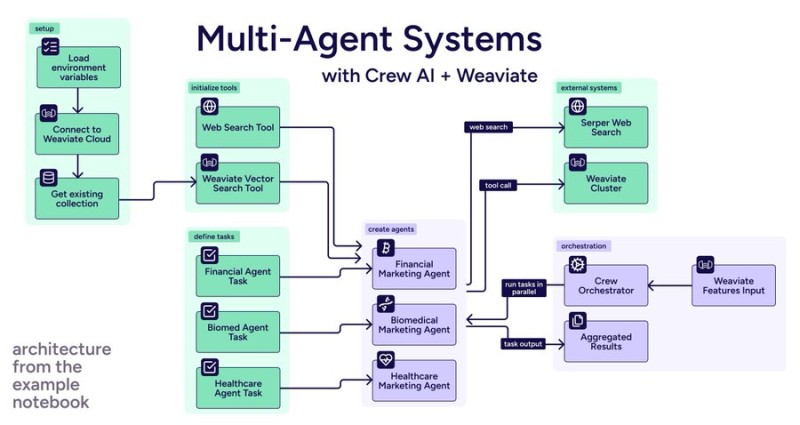
⬤ The architecture breaks down complex workflows into teams of autonomous agents. Each agent gets its own role, specific tasks, and toolset—whether it's handling financial data, biomedical research, or healthcare operations. They run in parallel, doing their specialized jobs while an orchestration layer manages how they share results and coordinates their work. It's a distributed approach that puts control, transparency, and reliability front and center rather than hoping one AI can do everything.
⬤ The technical backbone here is CrewAI's Weaviate Vector Search tool integration. Agents can query semantic data stored in Weaviate clusters while pulling fresh information from web search APIs at the same time. This combo of internal vectorized knowledge and live external context means responses stay grounded in proprietary data without losing real-world relevance. External systems like search services and vector databases aren't bolted on as extras—they're built into the workflow from day one.
⬤ What this partnership really highlights is that orchestration and retrieval infrastructure aren't optional anymore—they're foundational. As companies shift from proof-of-concept demos to actual production systems, architectures like this represent where the market's heading: toward consistency, governance, and operational scale instead of just chasing the highest benchmark scores.
 Alex Dudov



