
 Eseandre Mordi
⬤ Mistral just released the Devstral 2 family—two open-source coding models built for automated software development. Both Devstral Small 2 and Devstral 2 are hitting state-of-the-art numbers on SWE-Bench Verified, which is a big deal for open-weight models. Best part? They're completely free to use, keeping things accessible for developers everywhere.
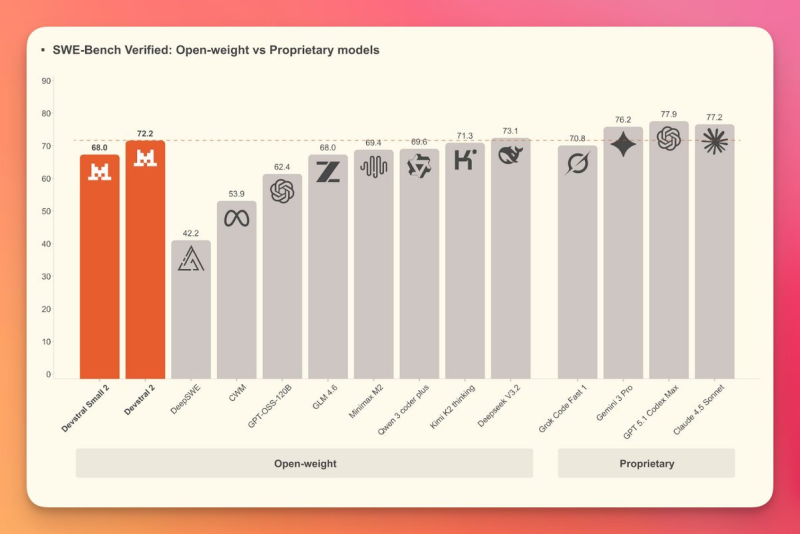
⬤ The benchmark numbers are impressive. Devstral Small 2 scores 68.0 on SWE-Bench Verified, while the bigger Devstral 2 hits 72.2. That puts them ahead of other open-weight competitors like DeepSWE, CWM, and GPT-OSS-120B—and they're closing in on several proprietary systems. What makes Devstral 2 really interesting is that it's a 24-billion-parameter model you can actually run on regular consumer hardware without sacrificing accuracy. That's huge for developers who want flexibility in how they deploy.
⬤ Mistral also launched Mistral Vibe—a command-line tool that handles end-to-end automation. It lets you route coding tasks through clean workflows, plug model outputs straight into your build systems, and automate all those repetitive engineering tasks nobody enjoys. The benchmark data shows the gap between open-source and proprietary coding models is getting smaller fast, which tells you how quickly the open ecosystem is improving.
⬤ This launch strengthens Mistral's foothold in the AI-powered software engineering space. By offering high-performing models that are open, efficient, and run locally, they're ramping up competition across the board. These moves could reshape how companies adopt AI tools, how models get deployed, and the whole economics of AI-assisted development.
 Eseandre Mordi



