
 Saad Ullah
⬤Fresh aggregated data from 100 companies is giving marketers something to chew on: not all AI traffic is created equal. Looks at conversion rates driven by four major AI assistants - ChatGPT, Google Gemini, Perplexity, and Claude - and the differences are real enough to matter for how businesses think about AI visibility.
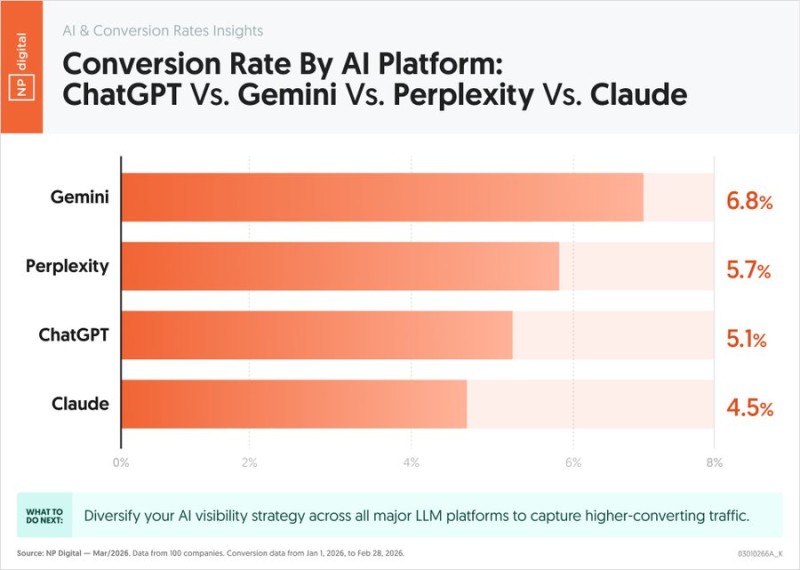
⬤Google Gemini tops the ranking with a conversion rate of roughly 6.8% between January and February 2026. Perplexity comes in second at around 5.7%, followed by ChatGPT at approximately 5.1%. Anthropic's Claude trails the group at about 4.5%. The gap between first and last is over two percentage points - not a rounding error when you're talking about sign-ups or purchases at scale.
⬤The data doesn't suggest any platform is sending bad traffic - all four are producing meaningful visitor flows. But the spread raises a reasonable question: why does Gemini's audience convert more? Intent and context likely play a role. Users arriving via different assistants may be at different stages of their decision journey. What the report makes clear is that optimizing for one AI platform while ignoring others is probably a mistake. The ChatGPT group chat rollout - now supporting up to 20 participants across four countries - signals that these platforms are actively expanding how users interact with AI, which will only add more complexity to traffic behavior going forward.
⬤The broader takeaway is that AI assistants are quietly becoming a significant traffic channel - one that behaves differently from organic search or social referrals. As these tools evolve into recommendation and discovery interfaces, conversion performance gaps could shape where brands invest their content and optimization efforts. The smart play is treating AI platforms as distinct channels, each with its own audience behavior, rather than a monolithic "AI traffic" bucket.
 Saad Ullah



