
 Saad Ullah
Anthropic drew attention after its reasoning model Claude Opus 4.6 reportedly solved a mathematical conjecture posed by legendary computer scientist Donald Knuth. In a note titled "Claude's Cycles," Knuth wrote that an open problem he had been working on for several weeks had already been solved by the model. Knuth described the discovery as both surprising and joyful, noting that the development may require him to revise his views on generative AI and its role in research.
Hamiltonian Cycles and the m³ Vertex Problem
The problem emerged from Knuth's work on directed Hamiltonian cycles while preparing material for a future volume of The Art of Computer Programming. The challenge involved decomposing the edges of a directed graph with m³ vertices into three Hamiltonian cycles that each visit every vertex exactly once. According to reports, Anthropic's Claude Opus 4.6 explored multiple computational strategies and eventually identified a construction method that works for all odd sizes of the graph.
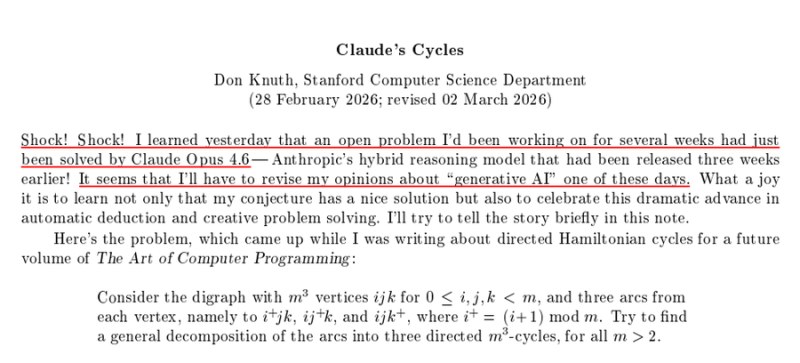
Knuth later verified the structure and produced the formal mathematical proof explaining why the solution works. The development highlights the expanding capabilities of modern reasoning models in complex analytical domains such as mathematics and algorithm design.
Growing Role in Computational Discovery
Anthropic's Claude family has recently gained traction in enterprise AI adoption and developer ecosystems. Industry coverage notes the model's rapid adoption across enterprise environments, while educational initiatives like Anthropic's free prompt engineering course hitting 31,900 GitHub stars reflect growing interest among developers and researchers exploring advanced AI tools.
The episode illustrates how large language models are increasingly being tested in areas once considered exclusive to human researchers. While the mathematical proof still required human verification, the model's ability to propose a working construction for a long-standing conjecture suggests that AI systems may play a growing role in computational discovery, automated reasoning, and collaborative scientific research in the years ahead.
 Saad Ullah



