
 Usman Salis
⬤Alibaba (BABA) has launched OpenSandbox, an open-source platform that gives AI agents a secure, isolated space to execute code, browse the web, and train models. Built on the same internal stack powering Alibaba's own large-scale AI workloads, the platform delivers a unified API and infrastructure layer for running AI tasks across multiple environments.
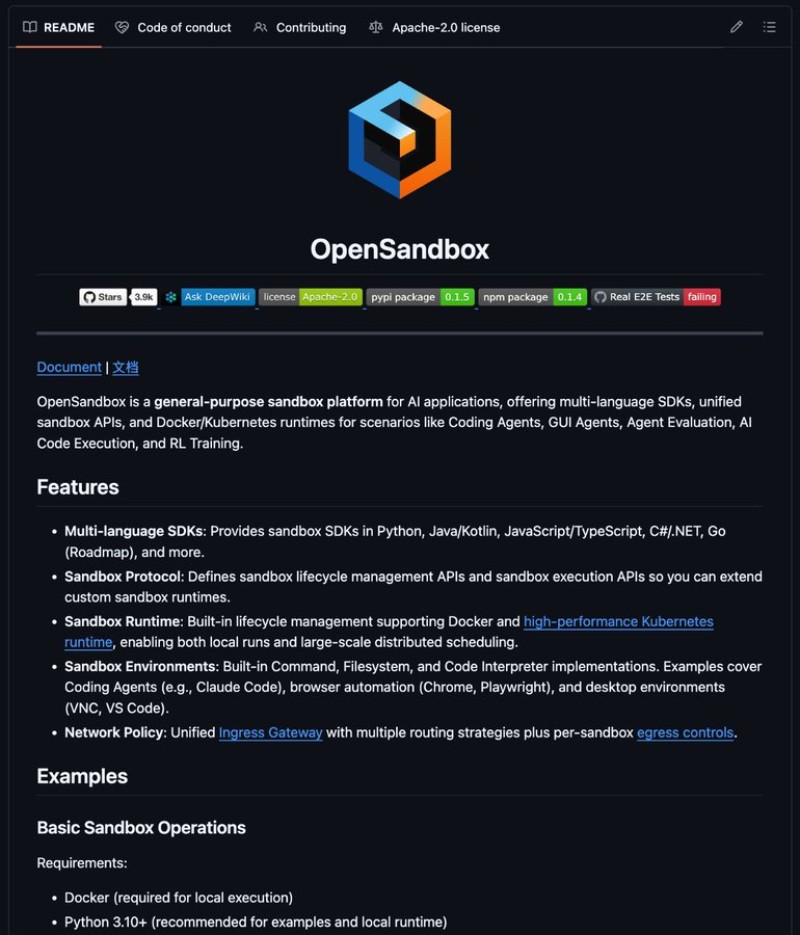
⬤OpenSandbox functions as a general-purpose sandbox infrastructure for AI applications. It supports coding agents that write and debug software, GUI agents interacting with graphical desktops via VNC sessions, and high-performance runtimes for compute-heavy code. The platform also handles reinforcement learning workflows, providing containerized environments where AI models safely run repeated experiments in isolated RL training loops.
⬤The architecture covers both local development and cloud-scale deployment. Developers can spin up sandbox environments locally via Docker for rapid testing, while production workloads scale through Kubernetes. OpenSandbox currently ships SDKs for Python, TypeScript, and Java/Kotlin, with C# and Go support planned ahead. Setup takes a single command-line step, after which the server launches and exposes an API that agents use to interact with sandboxes.
⬤OpenSandbox reflects a broader industry push toward open infrastructure for autonomous agents. As AI systems increasingly operate within software environments and external tools, safe execution platforms are becoming essential. This release arrives alongside major capital moves in AI, including NVDA and AMZN backing OpenAI's $110B raise at a $730B valuation. Meanwhile, open-source efficiency gains like MiniMax M2.5, which challenges Claude Opus at 95% lower cost and 3x speed, show how quickly the competitive landscape is shifting. Together, these developments highlight why infrastructure tools like OpenSandbox are becoming critical building blocks for the next generation of AI systems.
 Usman Salis



