
 Peter Smith
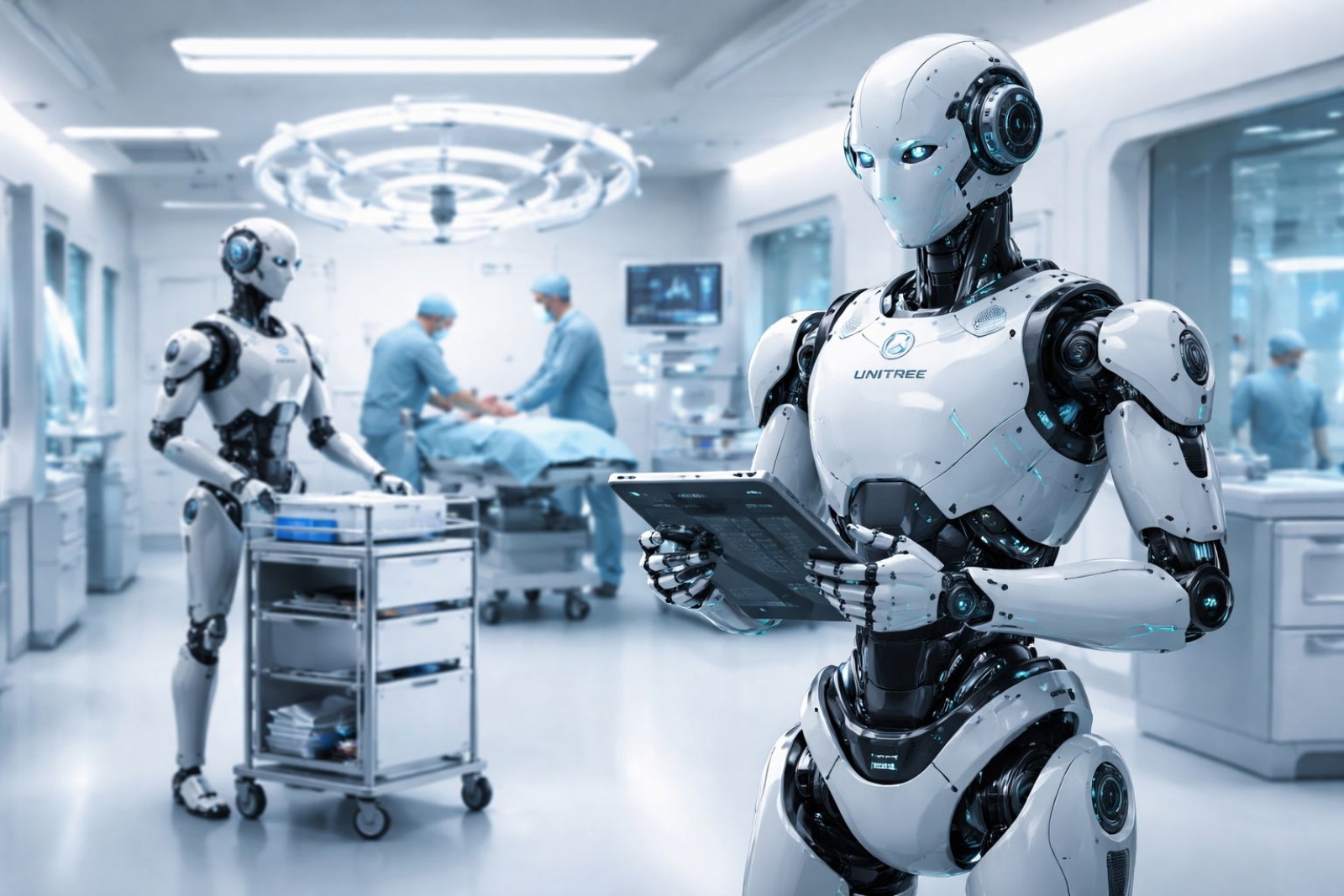
Hospitals are beginning to pilot humanoid robots to support routine operations, reflecting a growing shift toward automation in healthcare environments. Institutions such as the University of Tsukuba Hospital in Japan are testing systems including the Unitree G1 humanoid robot, as reported by CyberRobo. The deployments are focused on assisting staff with non-clinical tasks rather than replacing medical professionals, as healthcare systems continue to face labor shortages and rising workloads.
Unitree G1 Robot Tested Across 4 Key Hospital Functions
The pilot programs demonstrate several practical applications for humanoid robots within hospital settings. China already leads global humanoid robot shipments in 2025, with Unitree accounting for 5,500 units - context that makes these hospital deployments part of a much larger rollout. Robots are being tested for the following functions:
- Autonomous navigation through hospital corridors and dynamic indoor spaces
- Patient guidance and voice-guided interaction
- Facility patrol and monitoring
- Delivery of items within hospital environments
These capabilities are enabled by integrated systems that allow obstacle avoidance and real-time task execution.
The goal is to reduce the burden of indirect tasks that often consume staff time without contributing directly to patient care.
Humanoid Robot Deployments Signal a Broader Industry Shift
The deployment of humanoid robots reflects broader industry momentum toward automation in service sectors. Advances in tactile technology are also contributing to this shift - three open-source robotic hands can now sense touch in real time, expanding what robots can physically do in complex environments. By focusing on repetitive and logistical responsibilities, these systems aim to improve operational efficiency while keeping clinical staff available for higher-value work.
The increasing presence of humanoid robots in hospitals highlights a transition toward hybrid human-machine workflows - a shift that is expected to accelerate as mobility, perception, and interaction capabilities continue to improve.
Hospital Robots and the Future of Human-Machine Workflows
As these systems continue to improve, they are expected to play a larger role in supporting healthcare infrastructure. This trend aligns with ongoing advancements in robotics simulation and training - Kinema4D has unveiled a 4D generative robotics simulation platform backed by the RoBo4D-200K dataset, signaling continued progress toward scalable and practical deployment of robotic assistants across healthcare and beyond.
 Peter Smith



