
 Saad Ullah
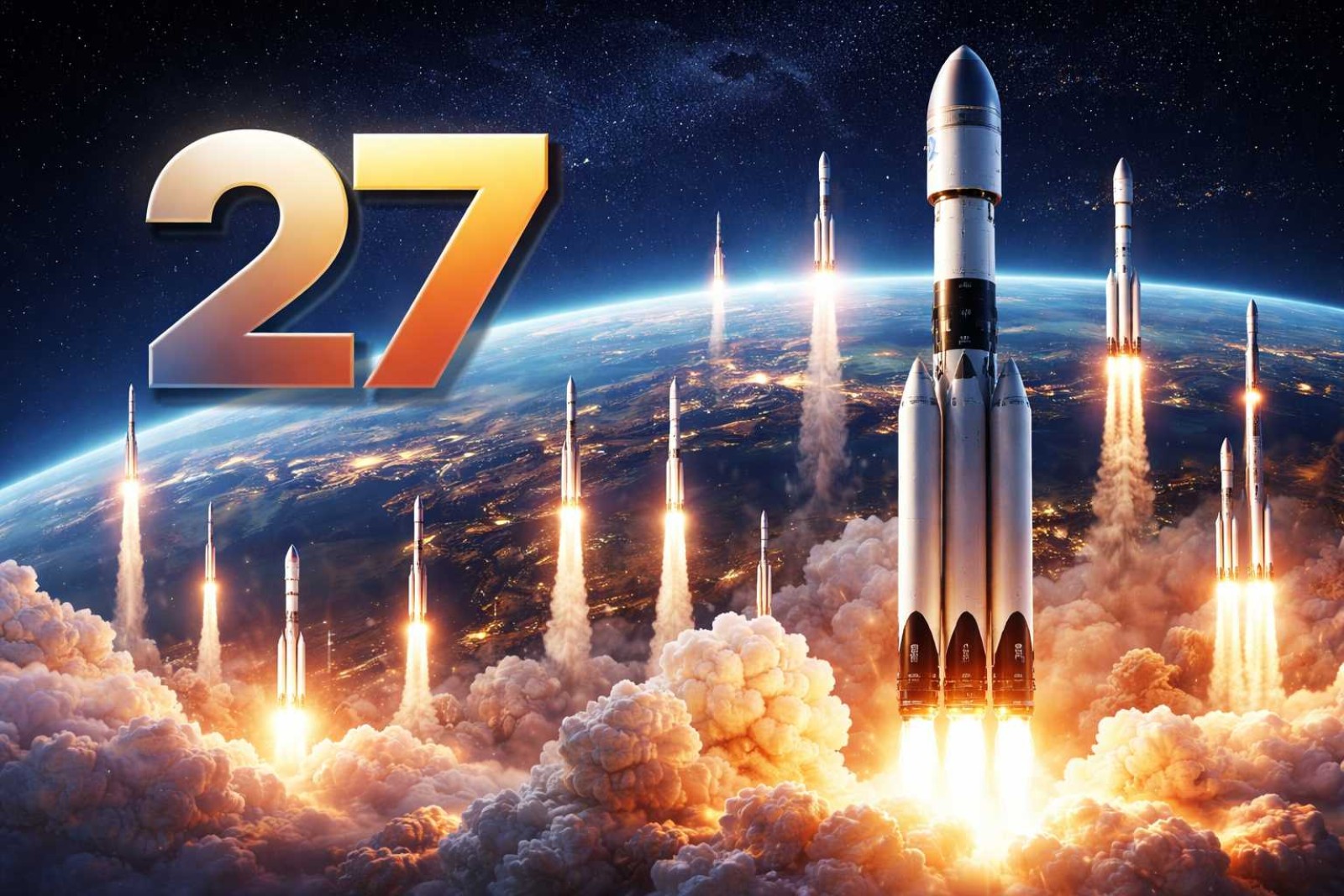
⬤ SpaceX has taken a commanding lead in global launch activity in 2026, completing 27 successful orbital missions so far this year. Recent Falcon 9 flights deploying Starlink satellites have kept the company's cadence high, reinforcing its grip on the commercial space industry at a pace that leaves competitors far behind.
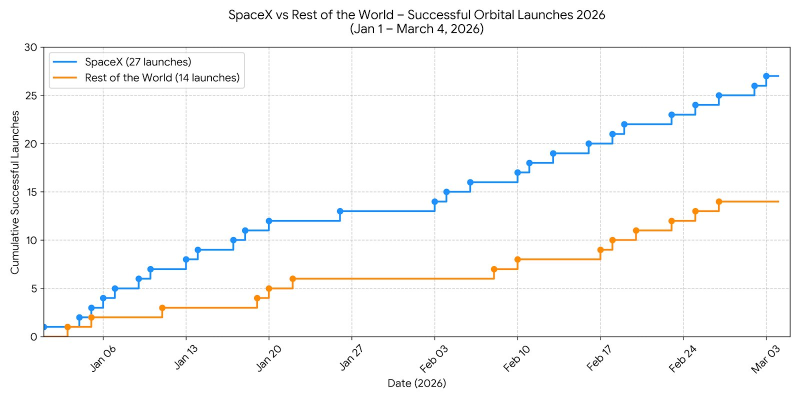
⬤ The numbers tell a stark story: while SpaceX racked up 27 launches, every other provider on the planet combined managed just 14 over the same stretch. The gap underscores how quickly the company has scaled relative to national agencies and rival startups. The broader technological context — where AI and space infrastructure increasingly overlap — is examined in SpaceX and xAI eye space as AI crashes into Earth's 100% energy wall.
The Falcon 9's reusability has changed what's possible — not just for SpaceX, but for what the industry expects from a modern launch vehicle.
⬤ The reusable Falcon 9 is at the core of SpaceX's advantage. Booster recovery dramatically cuts costs and shortens turnaround between missions, letting the company sustain a cadence rivals simply can't match. For context on how high-performance computing benchmarks are shaping aerospace engineering alongside this expansion, see NVDA-linked AI benchmarks: Falcon-H1-7B scores 16 on intelligence index.
⬤ SpaceX's momentum also points toward much bigger ambitions — large-scale satellite constellations, deep-space missions, and next-generation heavy-lift rockets. Starship, which delivers twice the thrust of the Saturn V, is central to those plans. The full picture is laid out in TSLA SpaceX Starship produces 2× Saturn V thrust, Musk explains Mars mission.
 Saad Ullah



