
 Peter Smith

Training large language models has always involved a difficult choice: optimize for stability or push for maximum performance. Now, a collaboration between Tsinghua University and Alibaba's Qwen team has introduced a breakthrough architecture that promises both. Their new SiameseNorm method uses a creative dual-stream approach to improve how AI models learn, potentially changing how future systems are built.
Breaking the Stability-Performance Trade-Off
Researchers from Tsinghua University and Alibaba's Qwen team have introduced SiameseNorm to tackle a persistent challenge in large language model development. The method uses a two-stream design that splits the learning process into parallel paths. One stream focuses on mathematical stability during training, while the other emphasizes raw representational power.
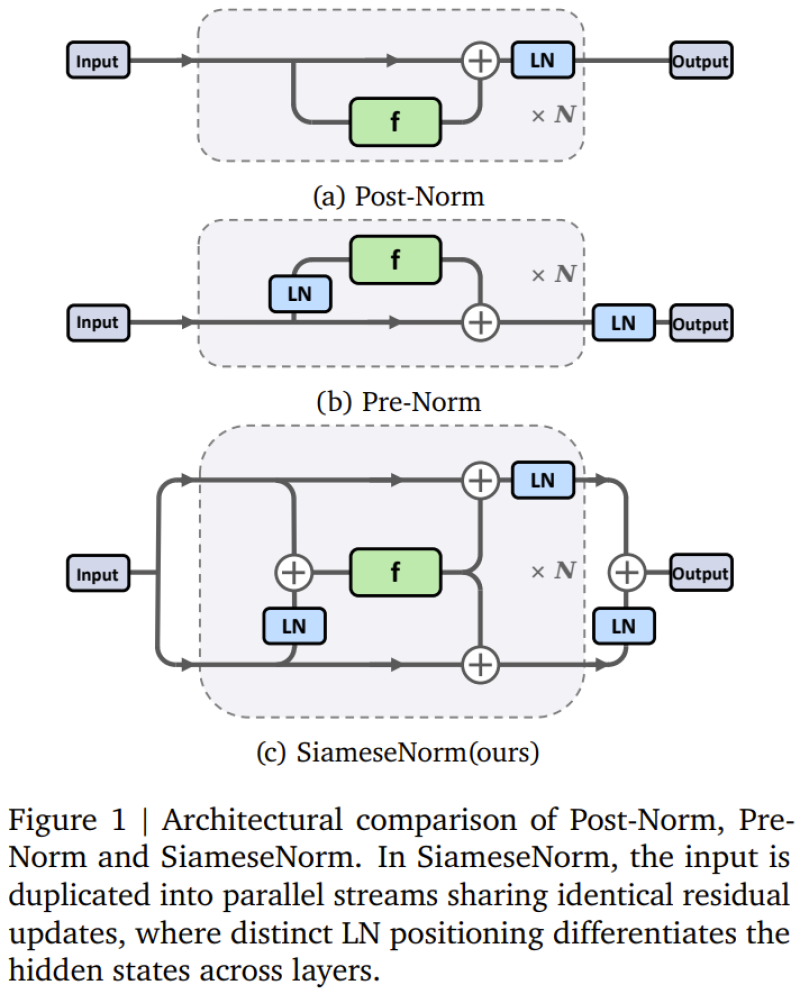
This architectural innovation differs significantly from traditional post-norm and pre-norm transformer designs. Classic setups pass data through normalization either before or after application functions using a single residual flow, which often causes training instability at scale. SiameseNorm takes a different approach by duplicating the input into parallel streams that share residual updates but use distinct layer normalization placements across streams.
How SiameseNorm Works
The dual-path architecture generates differentiated hidden states by processing information through two separate channels simultaneously. This design maintains mathematical rigor during optimization while enabling stronger feature extraction and model intelligence in the second stream.
The goal is to maintain mathematical rigor during optimization while enabling stronger feature extraction and model intelligence.
Initial testing on models with approximately 1.3 billion parameters demonstrated that SiameseNorm significantly improves training robustness and consistently outperforms conventional transformer normalization across multiple benchmarking tasks. The dual-path design prevents training crashes without sacrificing performance gains.
Broader Impact on AI Development
The development of architectures like SiameseNorm fits within larger trends in AI research. Alibaba recently integrated Qwen into the revamped Quark AI browser to expand real-world usage, while efficiency improvements such as Nanobot cutting agent code by 99% highlight growing industry focus on scalable, practical AI tools.
These advancements underscore increasing emphasis on architectures that deliver both performance and production-readiness. As the AI field matures, innovations that balance efficiency, stability, and capabilities become increasingly valuable for developing systems that work reliably at scale.
 Peter Smith



