
 Sergey Diakov

⬤ OpenAI just dropped some eye-opening numbers that show exactly how their money-making machine works. The company's CFO shared a chart that basically proves what insiders have suspected—their revenue growth moves in lockstep with how much computing power they've got running. We're talking about a pretty dramatic climb: from around 0.2 gigawatts back in 2023 to about 0.6 gigawatts in 2024, and they're projecting they'll hit roughly 1.9 gigawatts this year.
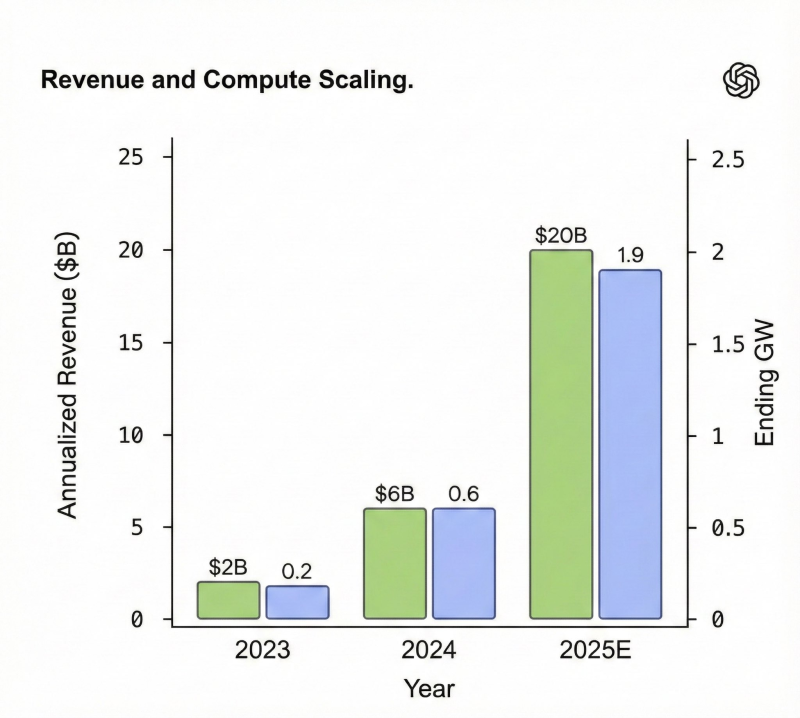
⬤ The money side of things tells the same story. Their annualized revenue jumped from about $2 billion in 2023 to somewhere around $6 billion in 2024, and they're expecting to reach nearly $20 billion in 2025. What's interesting is that OpenAI's own commentary suggests they could've grown even faster if they'd had more compute available earlier. In other words, they're not struggling to find customers—they're struggling to build enough infrastructure to serve them.
⬤ This is where things get weird compared to normal tech companies. Most software businesses grow by adding users or expanding their sales teams. OpenAI's growth is literally measured in gigawatts—pure physical infrastructure. While typical software companies have seen their valuations take a beating lately, OpenAI's fundraising multiple stays sky-high because investors understand this is a completely different beast. They're not demand-limited; they're infrastructure-limited.

⬤ Here's why this matters for everyone watching the AI space: OpenAI is showing us that cutting-edge AI platforms don't scale like traditional software. They scale like power grids or telecom networks. Revenue growth depends on capital investment, access to electricity, and how fast you can build data centers. As OpenAI keeps expanding their compute capacity, their revenue will keep climbing in proportion—making energy access, hardware supply chains, and infrastructure planning the real bottlenecks in the AI race.
 Sergey Diakov



