
 Marina Lyubimova

AI systems that review code still make surprisingly basic mistakes: they skim function names, spot familiar patterns, and jump to conclusions without actually reading what the code does. A new paper from Meta AI research shows 93% code verification accuracy is possible by simply forcing models to think more carefully before they answer.
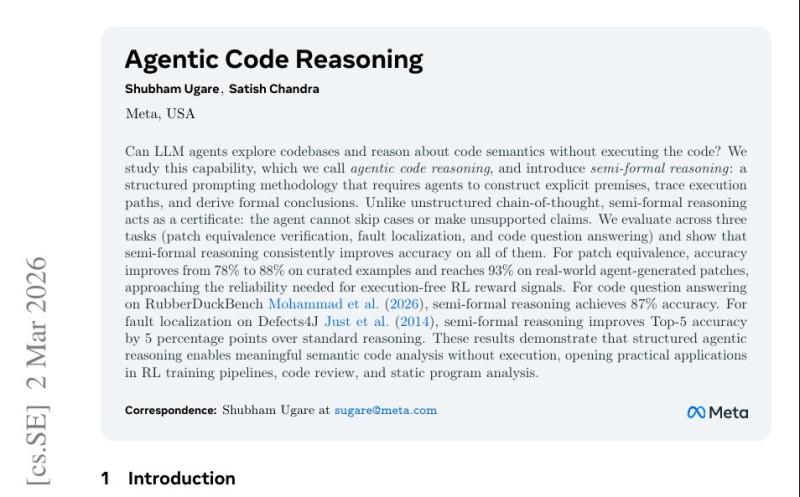
The research, titled Agentic Code Reasoning, presents a structured prompting framework that requires large language models to reason through code step by step. Instead of relying on surface-level pattern recognition, the system constructs explicit premises, traces execution paths, and gathers evidence before drawing any conclusions about how a code change behaves.
How Semi-Formal Reasoning Cuts Errors in Automated Code Review
The core technique is what the authors call semi-formal reasoning: a checklist-style approach that prevents AI agents from skipping logical steps. Traditional code analysis lets models make confident assumptions based on keywords or function signatures without examining the underlying files. This new framework demands that the model read actual code and verify each claim before completing its analysis.
Structured reasoning allows AI systems to perform deeper semantic code analysis without executing the software itself.
The practical difference is significant. In patch equivalence verification, accuracy climbed from 78% to 88% on curated datasets, and hit 93% on real-world agent-generated patches. The framework also scored 87% on the RubberDuckBench code question-answering benchmark, while fault localization improved by roughly five percentage points over standard reasoning methods. All of this happens without ever running the code.
What This Means for the Future of AI Developer Tools
Reliable code verification without runtime testing environments could meaningfully reduce the cost of automated programming assistants. Spinning up execution sandboxes is expensive and slow; a model that can reason its way to the right answer just from reading source files is far more practical at scale. Meta's 3.5 billion daily users position it as an AI distribution leader, meaning advances like this have a realistic path to reaching developers at enormous scale.
The research also lands at a moment of heightened scrutiny for AI credibility. Earlier this year, Meta was roasted after a fake Superintelligence Labs post went viral, underlining how closely the company's AI reputation is watched. Solid peer-reviewed results like these serve a dual purpose: advancing the science and rebuilding confidence that Meta's AI work is grounded in rigorous engineering rather than hype.
For the broader industry, the lesson is straightforward. Better reasoning frameworks, not just bigger models, may be the most practical lever for improving AI reliability in real-world developer workflows.
 Marina Lyubimova



