
 Victoria Bazir
Microsoft Research, working alongside CUHK, has introduced the Medical AI Scientist - a system designed to handle the full arc of scientific research without human intervention. DailyPapers reported that the system achieves near-MICCAI-level quality across 171 clinical cases spanning 19 distinct tasks.
The framework covers the entire research pipeline from start to finish. It takes in medical datasets, task descriptions, and reference papers, then moves through idea generation, experimental execution, and manuscript creation. Multiple agent roles divide the work - some propose ideas, others run experiments, and others handle writing - creating a structured approach to automating what has traditionally been slow, human-driven work.
How the Medical AI Scientist Automates the Full Research Workflow
The architecture reflects something more ambitious than a writing assistant or data processor. By combining ideation, experimentation, and paper production under one roof, the system takes on the kind of sequential, judgment-heavy work that typically requires months and multiple specialists.
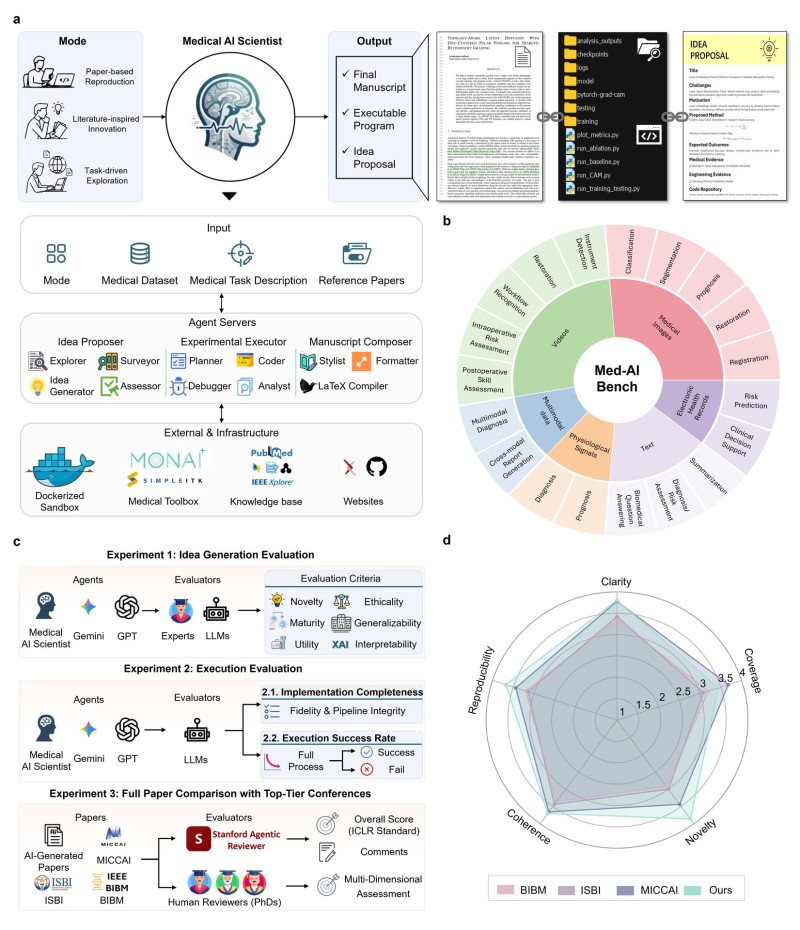
The evaluation benchmarks outputs against MICCAI standards - one of the most competitive venues in medical imaging research - and the results hold up.
Combining idea generation, experimentation, and writing within a single framework marks a real shift in how AI can participate in medical science - not just as a tool, but as a contributor to the research pipeline.
This matters beyond the headline numbers. Systems like MedixR1, which achieved 73.6% accuracy in AI-driven medical diagnosis, have shown that AI can reach clinically meaningful thresholds in specific tasks. The Medical AI Scientist pushes that further by targeting the research process itself, not just a single diagnostic output.
19 Tasks, 1 Pipeline: AI Research Automation Hits a New Benchmark
The breadth of the evaluation is worth noting. Covering 19 tasks across 171 clinical cases means the system wasn't optimized for a narrow domain - it had to perform across varied medical contexts, which is a harder and more realistic test than most benchmarks allow for.
Infrastructure developments are keeping pace. Google's release of MedGemma 1.5 with full 3D medical imaging support signals that the underlying tools available to medical AI are becoming more capable, making systems like the Medical AI Scientist increasingly viable for real research environments.
The results point to a broader shift - AI systems are moving from supporting individual research tasks to handling multiple stages of scientific work autonomously, in a way that begins to resemble how research teams actually operate.
The direction is clear: medical AI is no longer just reading scans or flagging anomalies. It is starting to do science.
 Victoria Bazir



