
 Peter Smith

Medical artificial intelligence is entering a new phase of sophistication. While traditional AI systems simply retrieve information and present it, newer frameworks are learning to reason through complex medical scenarios much like experienced clinicians do. MBZUAI's latest breakthrough, MediX-R1, represents a significant step forward in this evolution, demonstrating how reinforcement learning can train AI to generate thoughtful, clinically grounded responses across multiple imaging types.
How MediX-R1's 51K Training Examples Outperform Traditional Medical AI
AI hardware ecosystem stand to benefit substantially from rapid advancements in medical artificial intelligence. MBZUAI recently unveiled MediX-R1, an open-ended reinforcement learning framework designed to generate clinically grounded free-form responses. MediX-R1 leverages group-based reinforcement learning with composite rewards - including LLM accuracy, semantic alignment, format adherence, and imaging modality relevance - to achieve 73.6% accuracy on medical benchmarks using only around 51,000 training examples.
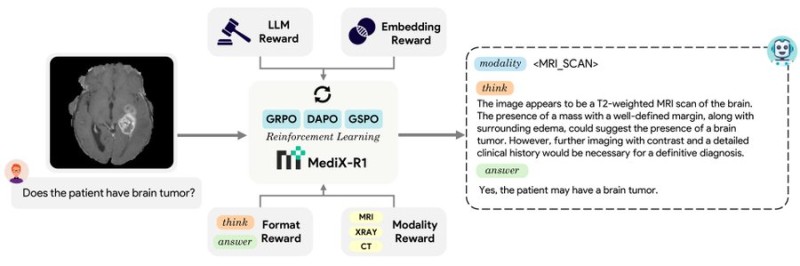
The framework processes MRI scans, X-rays, and CT images to produce contextually relevant clinical interpretations. Unlike traditional RAG (Retrieval-Augmented Generation) frameworks that remain fundamentally read-only, MediX-R1 integrates read-write reinforcement learning loops (GRPO, DAPO, GSPO). These enable the system to refine answers not just for accuracy but for clinical coherence across multiple imaging modalities.
Reinforcement Learning Drives Clinical Reasoning Beyond Simple Data Retrieval
This advancement mirrors the broader trend of AI tackling increasingly complex problems. The improvement in structured reasoning recalls when Grok 420 solved an advanced math problem in minutes that had challenged researchers for years. As one researcher noted, "The integration of reinforcement learning with composite reward signals represents a fundamental shift in how we approach medical AI - moving from static generation to adaptive learning frameworks."
The MediX-R1 architecture demonstrates how reinforcement learning with composite reward signals can drive substantial performance gains even with relatively modest dataset sizes. By simultaneously focusing on content accuracy, semantic richness, output formatting, and modality-specific evaluation, MediX-R1 moves beyond simple retrieval pipelines toward agents capable of clinically relevant reasoning.
The arrival of memory-enhanced and reinforcement-trained clinical AI frameworks like MediX-R1 signals a broader paradigm shift in how AI agents are evaluated and deployed across sectors where context, multimodality, and accuracy are essential. These trends heighten demand for scalable compute and high-performance accelerators while underscoring how AI is becoming increasingly integral to healthcare diagnostics, research, and personalized medicine. As AI platforms continue to evolve, the integration of medically grounded reasoning and advanced training paradigms may redefine expectations for next-generation intelligent systems.
 Peter Smith



