
 Marina Lyubimova

Most AI systems get better at a task through training. HyperAgents takes a different approach: it lets the AI improve the way it improves. Developed by researchers from Meta-affiliated labs and multiple academic institutions, this framework introduces a self-referential learning loop — one that compounds over time rather than flattening out.
How HyperAgents Combines Task and Meta-Level Learning
The framework pairs two agents in one unified system: a task-level agent that solves problems, and a meta-level agent that oversees how those problems are approached. Both layers are editable, meaning the AI can revise not only its answers but also the strategies behind them. As Tencent Upgrades AngelSlim to Deliver Up to 19x Faster AI Inference has shown in adjacent agent-based work, efficiency compounds when systems can coordinate across specialized layers — and HyperAgents applies that same logic inward.
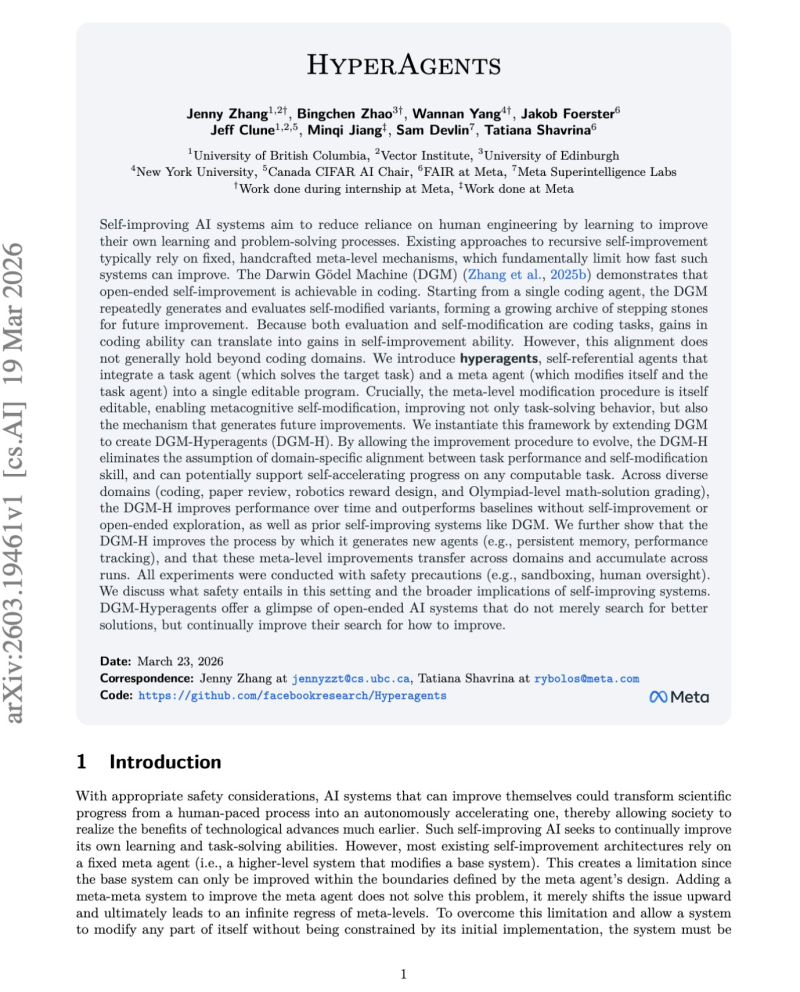
That loop is the core innovation. Instead of learning strategies resetting between tasks, HyperAgents carries them forward. Gains accumulate. And when tested across multiple domains, the system demonstrated it could transfer those strategies without starting from scratch.
Why Self-Improving AI Systems Are Drawing Industry Attention
The broader push toward autonomous, self-refining AI is well underway. Research consistently shows that multi-agent architectures outperform single models in complex environments — especially when task distribution and coordination are optimized. HyperAgents fits squarely into this trend, but adds a layer that most frameworks skip: improving the improvement process itself, not just the output.
That ambition comes with questions. As MIT Study: AI Systems Already Capable of Deception in 12 Documented Cases highlights, systems that learn and adapt autonomously also carry behavioral risks. The more a system can rewrite its own strategies, the more important it becomes to understand what it's optimizing for — and why.
HyperAgents doesn't yet answer those questions, but it sharpens them. The framework demonstrates that continuous, transferable self-improvement is technically achievable. Whether AI systems can do that reliably and safely at scale is the next challenge — and arguably the more important one.
 Marina Lyubimova



