
 Eseandre Mordi

⬤ A senior DeepMind scientist just gave the AI world something concrete to chew on. Shane Legg said AGI is "on the horizon" and attached real numbers to that claim: he sees a 50 percent chance we'll have minimal AGI by 2028. When pressed on what "on the horizon" actually means, he laid out the timeline directly in a public exchange that's now making the rounds online.
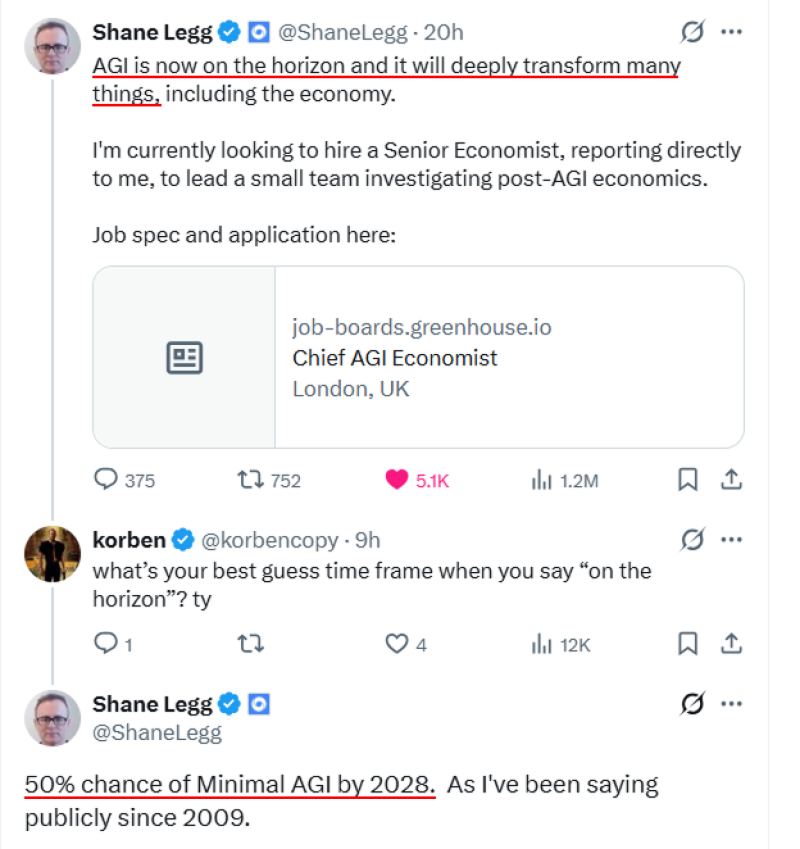
⬤ Legg didn't stop at predictions. He's also hiring—specifically, a senior economist to lead research into what the economy looks like after AGI arrives. That's not theoretical planning for some distant future. It's treating AGI as something that could land in the next few years, with real consequences for how money, work, and markets function. The combination of a timeline and active prep work suggests DeepMind is already positioning for a post-AGI world.
⬤ Interestingly, this isn't a new stance for Legg. He's been saying similar things since 2009, so this is less a sudden alarm bell and more a consistent view that's now getting closer to its target date. Still, "minimal AGI" wasn't clearly defined in the conversation, leaving room for interpretation about what capabilities that system would actually have if it shows up on schedule.

⬤ Why does this matter? When someone at DeepMind's level puts a number on AGI timelines, markets listen. These estimates shape how companies invest, how policymakers plan, and how entire industries think about their future. But without a clear benchmark for what "minimal AGI" means, there's risk in reading too much into any single timeline—even one from a scientist who's been thinking about this for over a decade.
 Eseandre Mordi



