
 Victoria Bazir

⬤ Here's what's happening: Chinese AI companies are absolutely crushing it in the open-weights model race. Data from Artificial Analysis shows they've been releasing stronger models consistently, pushing their intelligence scores from the mid-teens in 2024 all the way past 40 by early 2026. The chart tracking these releases tells a pretty clear story—China's on a steady climb while the US basically flatlined.
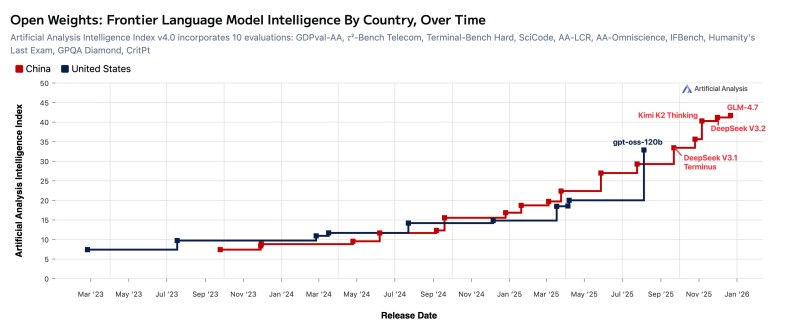
⬤ What makes this interesting is how China did it. They didn't just drop one massive breakthrough and call it a day. Instead, models like DeepSeek V3.1 Terminus, DeepSeek V3.2, Kimi K2 Thinking, and GLM-4.7 came out in waves, each one pushing the envelope a bit further. You can literally see it on the chart—it looks like stairs going up, with each release adding a few more points to the intelligence score. That's a completely different approach from what we saw in earlier years when progress was way more gradual.
⬤ Now compare that to what's happening in the States. The strongest US open-weights model is still gpt-oss-120b, which came out back in August 2025. It hit an intelligence score in the low 30s—solid at the time—but nothing's come close to beating it since. So while China kept releasing better models through late 2025 and into 2026, the US basically stayed put at that 30-point mark. That gap's only getting wider.

⬤ Why does this matter? Open-weights models aren't just academic exercises—they're what researchers use to experiment, what companies deploy for real applications, and what drives innovation across the board. China leading this space means they're setting the pace for what's publicly available at the frontier. The big question now is how fast US labs can fire back with something new, because that's going to shape everything from competitive dynamics to how open AI development evolves globally.
 Victoria Bazir



