
 Peter Smith
⬤ China is getting ready to put artificial intelligence at the heart of its next Five-Year Plan—the country's main blueprint for economic strategy—set to launch in March 2026. The government has mapped out a three-stage AI rollout over the next decade. The first phase kicks off in 2027, targeting six key areas: research and development, manufacturing, consumer products, healthcare and education, digital government services, and tech exports. This includes an "AI+" initiative that weaves AI into existing systems, like "AI+ Energy" for managing the national power grid.
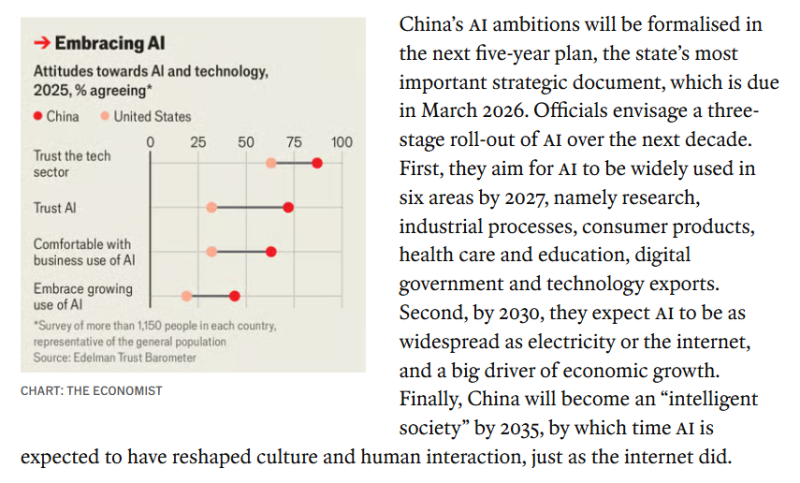
⬤ By 2030, Beijing expects AI to be everywhere—as common as electricity or the internet—and a major force driving economic growth. This push is part of China's broader effort to become self-sufficient in critical technologies like semiconductors and AI, a shift that global tech companies are watching closely. The plan builds on the current 14th Five-Year Plan, which focuses on "dual circulation"—strengthening domestic markets while keeping export channels open. Surveys show that Chinese citizens generally trust AI and tech companies more than Americans do.
⬤ The final phase targets 2035, when officials envision China as an "intelligent society" where AI is woven into the economy, government operations, and everyday life. They compare the expected transformation to the internet revolution—AI won't just be another tech sector, but a fundamental layer underneath everything from factories to hospitals to schools.
⬤ For global markets, China's detailed AI roadmap signals sustained demand for computing infrastructure, data centers, software platforms, and advanced chips over the next decade. The strategy underscores the intensifying competition in AI between major economies. With Beijing committing to more than ten years of coordinated support, Chinese companies and investors will likely keep pouring resources into AI, reshaping the country's growth trajectory and its position in the global tech landscape.
 Peter Smith



