
 Peter Smith

⬤ A new study from ByteDance Seed, in collaboration with Carnegie Mellon University and Fudan University, introduces behaviorally calibrated reinforcement learning to reduce hallucinations in large language models. The method trains models to recognize uncertainty and avoid generating incorrect answers — a growing priority as major tech companies expand AI integration, alongside broader progress highlighted in MedOS sets new SOTA in clinical reasoning beating GPT-5.
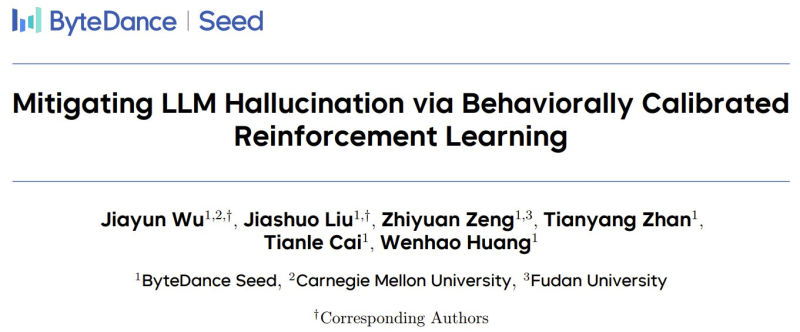
⬤ The research focuses on aligning model behavior with actual confidence levels. Systems can either abstain from answering when uncertainty is high or flag specific claims as unreliable. Unlike standard RL setups that reward correct answers and penalize errors, this framework incentivizes models to admit what they don't know. As the study notes, traditional training often pushes models to behave like "good test-takers" — guessing even when confidence is low. Behavioral calibration introduces probability-based decision-making instead, improving reliability in real-world use cases.
⬤ Empirical results show that a 4B parameter model trained with this method achieves better hallucination reduction in mathematical reasoning tasks than GPT-5, while reaching uncertainty calibration levels comparable to Grok-4 and Gemini-2.5-Pro. This suggests uncertainty awareness can develop as a transferable capability, independent of model size — a trend reflected in AI stock trading test shows Grok-4 leads with 82% gain.
⬤ The findings signal a broader shift in AI development — from chasing pure accuracy metrics toward building reliability and transparency. Reducing hallucinations is becoming as critical as raw performance, a shift also tied to wider market momentum covered in AAPL, NVDA jump 170% as consumer sentiment hits multiyear lows, where AI performance gains increasingly drive technology adoption and investor confidence.
 Peter Smith



