
 Marina Lyubimova

⬤ McKinsey Global Institute recently published research tracking the explosive growth in AI-related job requirements across the workforce. The data shows that demand for AI fluency—the ability to use and manage AI tools in daily work—has increased roughly seven times between 2023 and 2025. This analysis examined U.S. job postings where AI-related skills appeared in at least five percent of listings, giving a clear picture of how employer needs are rapidly evolving.
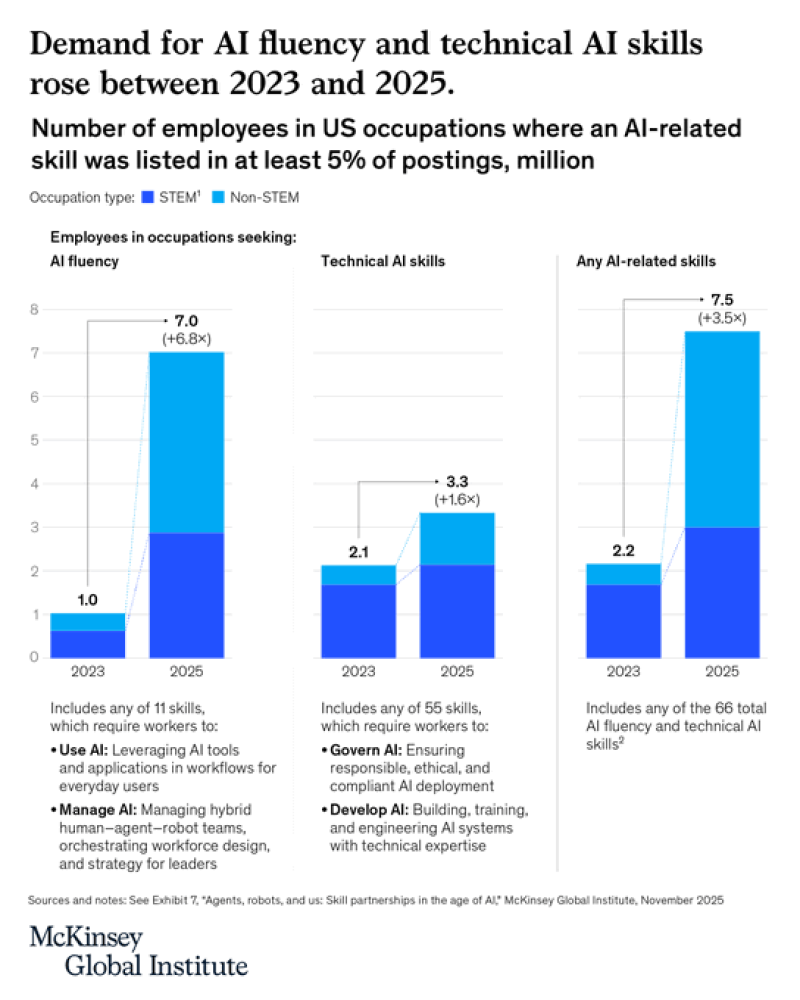
⬤ The numbers tell a striking story: roles requiring AI fluency grew from about 1 million employees in 2023 to approximately 7 million by 2025. This category outpaced every other skill group in the study. AI fluency roles include positions where workers need to leverage AI tools within their workflows, manage AI-enabled processes, and coordinate between human decision-making and automated systems. The data shows this type of demand expanded much faster than the need for deep technical AI expertise.
Demand for AI fluency, defined as the ability to use and manage AI tools in everyday work, increased roughly sevenfold over a two-year period.
⬤ Technical AI skills also saw growth, though at a slower rate. Jobs requiring capabilities like developing, governing, or maintaining AI systems rose from roughly 2.1 million employees in 2023 to about 3.3 million in 2025. Combined, total AI-related demand jumped from around 2.2 million roles in 2023 to approximately 7.5 million in 2025, spanning both STEM and non-STEM positions including management, compliance, and operational leadership.

⬤ The findings reveal a fundamental shift in how companies are adopting AI. Instead of limiting demand to specialized tech roles, employers now prioritize broad AI literacy across their entire workforce. This suggests the future job market will be shaped not just by AI development itself, but by how effectively millions of workers can actually apply these tools. As AI adoption scales, the emphasis on widespread AI fluency shows how human skill requirements are changing alongside the technology.
 Marina Lyubimova



