
 Usman Salis

⬤ Here's what's happening in the job market: Financial Times analysis of long-term U.S. labor data spanning 1980 to 2020 shows a massive split in how different workers are faring as AI takes over more tasks. The numbers track both employment levels and wages across different skill combinations, and the pattern is pretty clear—social skills are becoming the new currency.
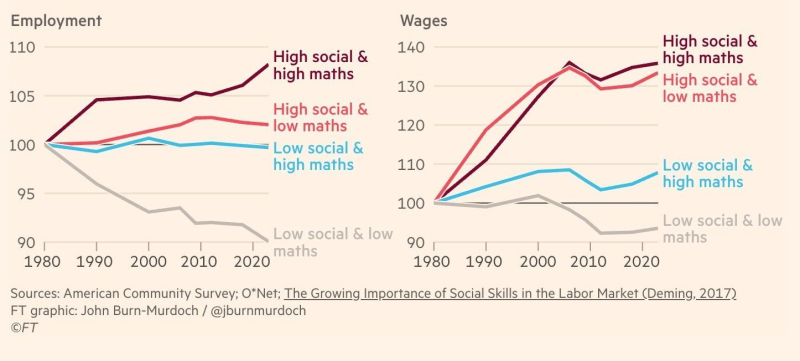
⬤ On the employment front, jobs that combine strong people skills with solid math abilities have been climbing steadily for forty years. Meanwhile, positions requiring minimal social interaction and basic math have tanked, with employment indices sliding toward 90 by 2020. Technical jobs that don't involve much human interaction? They've basically flatlined. What this tells us is that AI and automation are eating up routine work that doesn't require dealing with people, while roles that mix problem-solving with collaboration are thriving.
⬤ The wage story is even more dramatic. Workers in high-social roles have seen their pay shoot up into the 130-140 range on the wage index over this period. Even if your math skills aren't exceptional, strong social abilities translate directly into better paychecks. On the flip side, wages for low-social, low-math positions have gone nowhere—or worse—showing how the economy is increasingly rewarding human connection over routine tasks.
⬤ Why does this matter? Because we're watching a fundamental shift in what the economy values. As machines handle more technical and repetitive work, the premium is moving to skills that can't be easily automated—communication, teamwork, creative thinking, leadership. This reshaping affects everything from productivity patterns to income inequality to how we should be training the workforce for what's coming next in an AI-driven world.
 Usman Salis



