
 Sergey Diakov

⬤ Here's something wild: artificial intelligence just pulled off what mathematicians have been dreaming about for decades. An AI system actually solved Erdos Problem #728 more or less on its own, with just a bit of iterative prompting and feedback. What makes this absolutely next-level is that the AI didn't just rehash some existing proof—it came up with something genuinely new that wasn't sitting in any published paper.
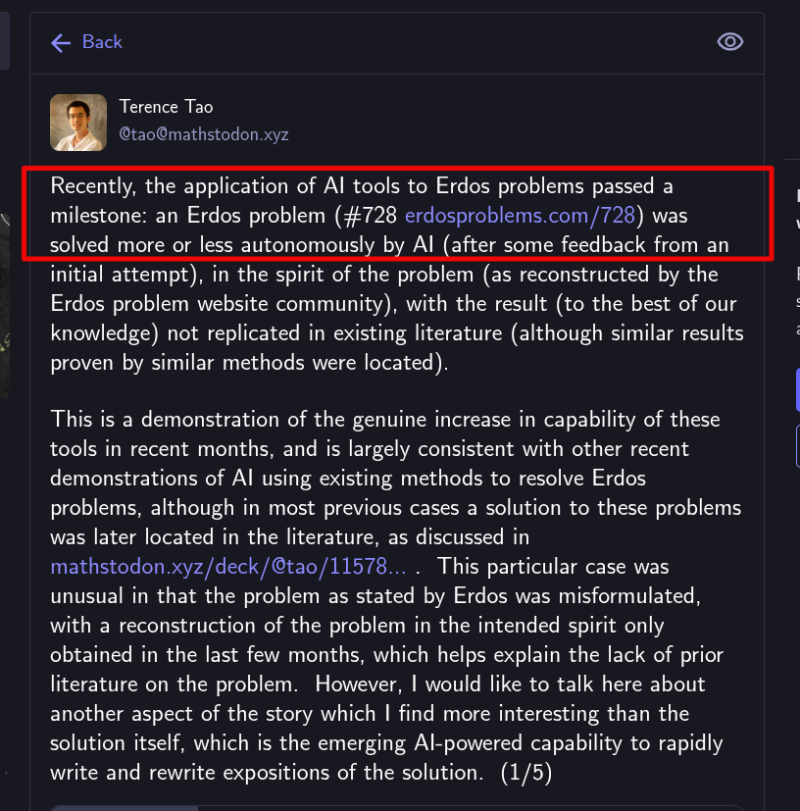
⬤ The system behind this breakthrough was GPT-5.2 Pro, which managed to generate its first complete proof for the problem. But here's where it gets really interesting: the team didn't stop at a chatbot spitting out natural language reasoning. They took that solution and translated chunks of it into Lean, which is basically the gold standard for formally verifying mathematical proofs.
⬤ The result? A Lean-verified proof that's been mechanically checked for correctness from top to bottom. This is huge because earlier AI math attempts usually produced informal arguments or just rediscovered stuff we already knew—and they needed tons of human cleanup. This time, the proof is original and rigorously validated.
⬤ What we're seeing here is AI moving from educated guessing into legitimate mathematical territory when paired with formal verification tools. The real game-changer is that AI isn't replacing mathematicians—it's becoming a genuine collaborator that can explore, refine, and validate complex ideas that automated systems couldn't touch before.
 Sergey Diakov



