
 Saad Ullah

⬤ A breakthrough AI system just proved that teamwork beats brute force. By coordinating multiple specialized models instead of relying on one massive language model, researchers achieved a 37.1% score on Humanity's Last Exam—a notoriously difficult reasoning benchmark—compared to GPT-5's 35.1%. The kicker? It didn't need bigger models or more parameters. It just needed smarter coordination.
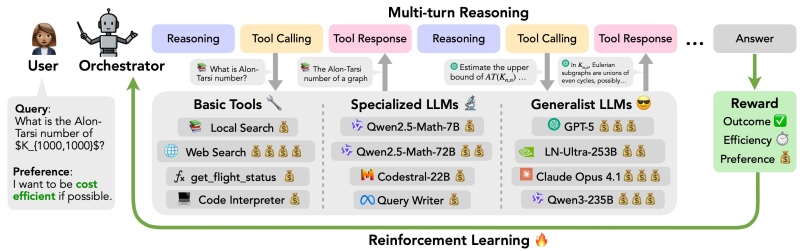
⬤ Think of it like an orchestra with a conductor. The system uses a conductor-style architecture where different models handle different jobs based on what they're good at. Heavy-duty models tackle the complex reasoning steps, while smaller, faster models knock out the routine stuff. A central controller acts as the brain, deciding in real-time which model or tool should handle each part of the problem. No wasted effort, no overkill.
⬤ That controller is trained with reinforcement learning, meaning it learns by trial and error to make the smartest decisions. It's laser-focused on three things: getting the right answer, doing it fast, and keeping costs down. Instead of following rigid scripts or prompt tricks, it adapts on the fly to whatever the task throws at it. The result is a system that's not just accurate—it's efficient.
⬤ The numbers back it up. The coordinated system didn't just edge out GPT-5—it ran roughly 2.5 times faster and slashed compute costs by around 70%. That's a massive win for anyone building or deploying AI at scale. It's also a signal that the future isn't about making models bigger. It's about making them work together smarter. Coordination, not size, might be the real breakthrough here.
 Saad Ullah



