
 Marina Lyubimova

The AI coding tools race has a clear leader in the distribution numbers, at least for now. A fresh dataset comparing Claude Code and Codex across package managers and GitHub activity shows Anthropic's tool pulling ahead on almost every metric that reflects real-world developer adoption.
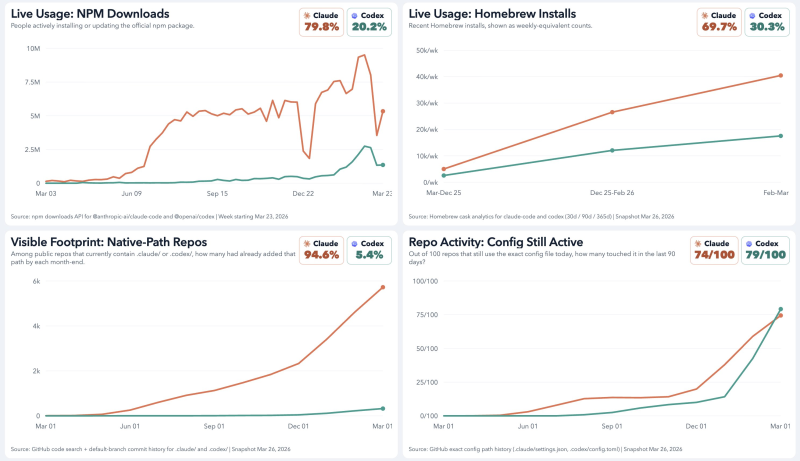
Peter Gostev compiled and shared the comparison, drawing on NPM downloads, Homebrew installs, and public repository data to build a picture of how developers are actually integrating these tools into their workflows.
Claude Code Claims 79.8% of NPM Downloads and 69.7% of Homebrew Installs Over Codex
The installation numbers are the most straightforward part of the dataset. Claude Code accounts for roughly 79.8% of NPM downloads against Codex's 20.2%. The Homebrew split is somewhat closer but still lopsided: Claude at 69.7% versus Codex at 30.3%.
These figures confirm stronger distribution of Claude Code across developer environments, particularly within package management ecosystems.
Package manager dominance matters because it reflects passive adoption. Developers installing through NPM or Homebrew are integrating a tool into their standard environment, not just running a one-off test. A nearly 4-to-1 ratio in NPM downloads is a meaningful signal about which tool is becoming the default choice.
Claude AI usage trends show a broader pattern here: experienced developers are driving adoption rather than casual users, which helps explain why distribution metrics are tracking so strongly across professional package management channels.
The repository data is where the picture gets more nuanced. Among public repositories using either tool, Claude-related paths (.claude/) account for approximately 94.6% of the total, with Codex at just 5.4%. On raw scale, that's not even a close contest.
Although Codex adoption is smaller, its user base remains highly engaged. About 79 out of 100 Codex repositories show recent updates, compared to 74 out of 100 for Claude.
That activity gap is worth flagging. Claude's repository footprint is enormous compared to Codex, but Codex users are slightly more likely to be actively committing. It's a classic reach versus engagement split: Claude Code has penetrated the ecosystem far more broadly, while Codex has cultivated a smaller but highly active developer base.
- Claude Code: 79.8% NPM downloads, 69.7% Homebrew installs
- Codex: 20.2% NPM downloads, 30.3% Homebrew installs
- GitHub repository share: Claude 94.6% vs Codex 5.4%
- Active repository rate: Codex 79/100 vs Claude 74/100
AI Developer Tooling Race Shows Claude Code Winning Distribution While Codex Retains Engaged Users
The distinction between scale and engagement is one that a direct Codex vs Claude Code comparison explores in depth. The two tools aren't necessarily competing for the same use case in every context, which may explain why Codex retains loyal, active users even as Claude Code dominates on distribution.
For Anthropic, the numbers represent meaningful traction in a market where developer mindshare is the long-term prize. For OpenAI, the Codex activity rate suggests its existing user base is deeply embedded even if broader adoption hasn't scaled to match Claude Code's reach. The gap across distribution metrics is large enough that it would take a significant shift to close, but the engagement data shows Codex isn't losing its core users.
 Marina Lyubimova



