
 Peter Smith

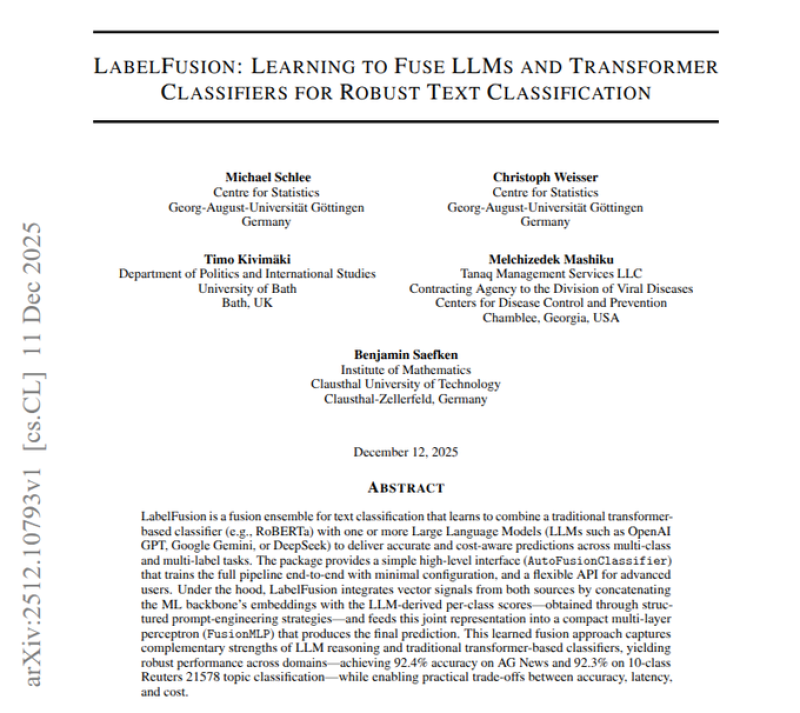
⬤ A new paper titled “LabelFusion - Learning to Fuse LLMs besides Transformer Classifiers for Robust Text Classification” offers a straightforward way to sort text more reliably. It pairs a plain transformer classifier with a large language model letting each side do what it does best before the system picks the safer answer.
⬤ The fast classifier trains once on labeled examples and needs only a quick forward pass - it scales to millions of items. It falters when the wording drifts away from its training set. The large language model follows written instructions plus copes with odd phrasing, but it costs more per query and responds more slowly. LabelFusion runs both, compares their evidence but also chooses the more trustworthy output for every single case.
The approach focuses on leveraging the complementary strengths of both systems to deliver more reliable predictions across different domains.
⬤ In numbers LabelFusion reaches 92.4 % accuracy on AG News and 92.3 % on Reuters 21578. A small neural network receives two pieces of information - a compact summary from the transformer as well as the large language model's confidence value for each label. The same network handles tasks that demand one label or multiple labels. By storing earlier large language model answers in a cache, the team lowers the bill and shortens the wait.
⬤ The study outlines a clear route for systems that must stay both correct or cheap. Text classification underpins news desks, support tickets, legal folders and many other chores - LabelFusion shows that a blend of classic models and large language models may soon become the everyday recipe for production grade tools.
 Peter Smith



