
 Usman Salis
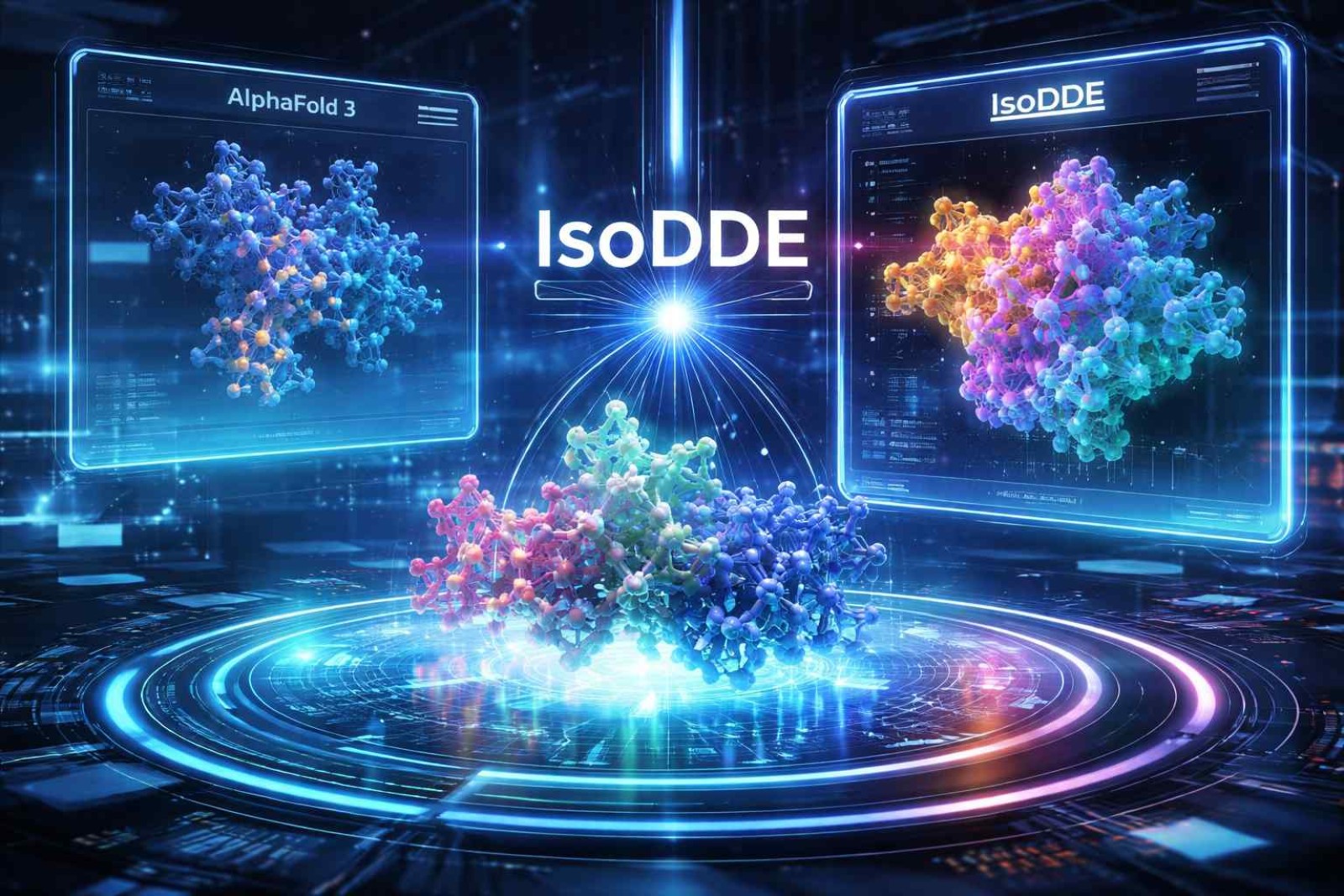
The race to accelerate drug discovery through artificial intelligence just got more interesting. Isomorphic Labs has unveiled benchmark results for its IsoDDE platform that challenge the current generation of protein modeling systems, potentially reshaping how pharmaceutical companies approach early-stage drug development.
IsoDDE Sets New Standards in Molecular Modeling
Isomorphic Labs introduced new research results for its drug design platform IsoDDE, highlighting advances in molecular modeling and binding prediction. The newly published technical report indicates the system progresses significantly beyond AlphaFold-class approaches across key evaluation metrics, positioning IsoDDE as a next-generation computational drug discovery tool.
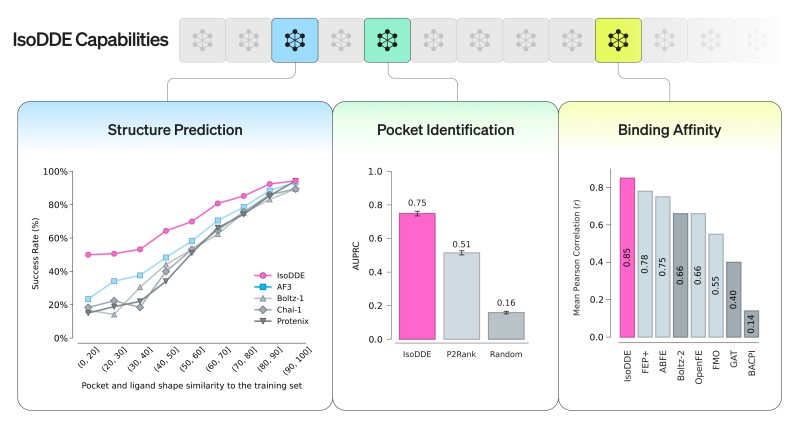
The accompanying benchmark chart compares IsoDDE against established protein modeling systems including AlphaFold 3, Boltz-1, Chai-1 and Protenix. In structure prediction tasks, IsoDDE shows consistently higher success rates across increasing levels of ligand similarity, reaching roughly mid-90% performance in the highest similarity range while competing models remain lower. The results suggest stronger structural accuracy when predicting molecular interactions under varying biological conditions.
Superior Performance Across Critical Drug Discovery Metrics
In pocket identification testing, IsoDDE records approximately 0.75 AUPRC compared with about 0.51 for P2Rank and roughly 0.16 for random prediction baselines. Binding affinity estimation also shows improvements, with IsoDDE reaching about 0.85 Pearson correlation, outperforming multiple existing methods including FEP+, ABFE, Boltz-2, OpenFE, FMO, GAT and BACPI. These metrics collectively measure how well an AI model can predict whether a drug molecule will interact with a biological target.
What This Means for Pharmaceutical Development
The report demonstrates accelerating competition in AI-driven pharmaceutical research, where performance gains in molecular modeling accuracy can influence development timelines and computational screening approaches across biotechnology and healthcare sectors. Smart money in biotech is watching closely—systems that can more accurately predict molecular interactions could cut years and billions from drug development cycles.
 Usman Salis



