
 Marina Lyubimova

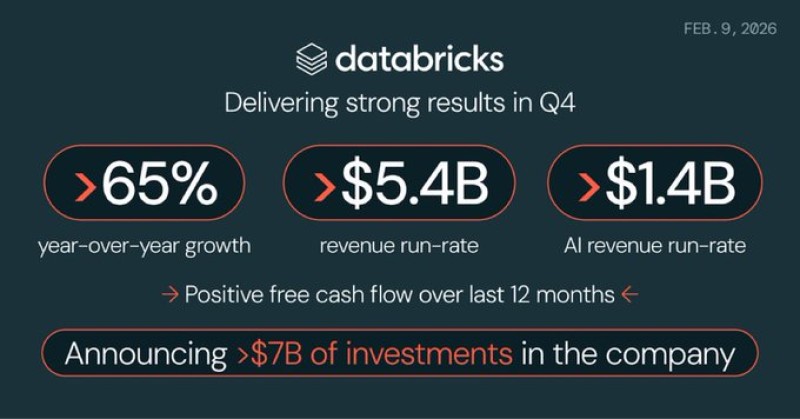
Databricks just shared its latest numbers, and they paint a picture of a company riding the AI wave hard. The data platform wrapped up Q4 with some serious momentum—65% year-over-year growth, positive cash flow, and AI revenue that's already hit a $1.4 billion run rate. What's really catching attention is how AI agents have taken over database creation on the platform, now accounting for 4 out of every 5 new builds.
Databricks Reports $5.4B Revenue Run Rate in Q4
According to Shay Boloor, Databricks exited the fourth quarter at a $5.4 billion revenue run rate, marking 65% annual growth while turning positive free cash flow. Those numbers put the company in rare territory for fast-growing enterprise software plays.
The platform is seeing something interesting happen with how databases get built. About 80% of new databases are now being created by AI agents rather than human engineers. That's a fundamental shift in how data infrastructure gets deployed.
AI Revenue Reaches $1.4B as Agents Take Over Database Creation
AI-specific revenue has hit a $1.4 billion run rate, driven largely by automated data workflows inside enterprise environments. Companies are increasingly letting AI agents handle the grunt work of setting up and managing data pipelines.
The combination of platform growth and rising AI usage reflects expanding reliance on automated tooling, the report noted.
This trend toward agent-driven systems is showing up across the industry—you can see similar patterns in AI agents across industries.
$134B Valuation Reflects Growing Enterprise AI Adoption
The company's current valuation sits near $134 billion, according to market commentary. That's the author's personal take on the 4% position sizing, but it reflects broader confidence in where data infrastructure is headed.
While Databricks doubles down on agent-driven database creation, other players are experimenting with different approaches. Some systems are moving away from vector databases entirely, like the file-based AI memory systems gaining traction in certain use cases.
The bottom line: automated database creation and AI-driven processing are becoming standard operating procedure in enterprise software, with Databricks sitting right in the middle of that transformation.
 Marina Lyubimova



