
 Usman Salis
The AI assistant landscape just got significantly more accessible. A new ultra-lightweight personal AI assistant named nanobot has emerged, proving that powerful agent functionality doesn't require massive codebases. By condensing what previously took over 430,000 lines of code down to roughly 4,000 lines of readable Python, nanobot is making AI assistant development more approachable for developers worldwide.
What Makes nanobot Different From Traditional AI Assistants
Nanobot was introduced as an ultra-lightweight personal AI assistant inspired by Clawdbot (insert link on Clawdbot). The project keeps core agent functionality while reducing the codebase by 99% — from more than 430,000 lines in Clawdbot to roughly 4,000 lines of clean, readable Python code.
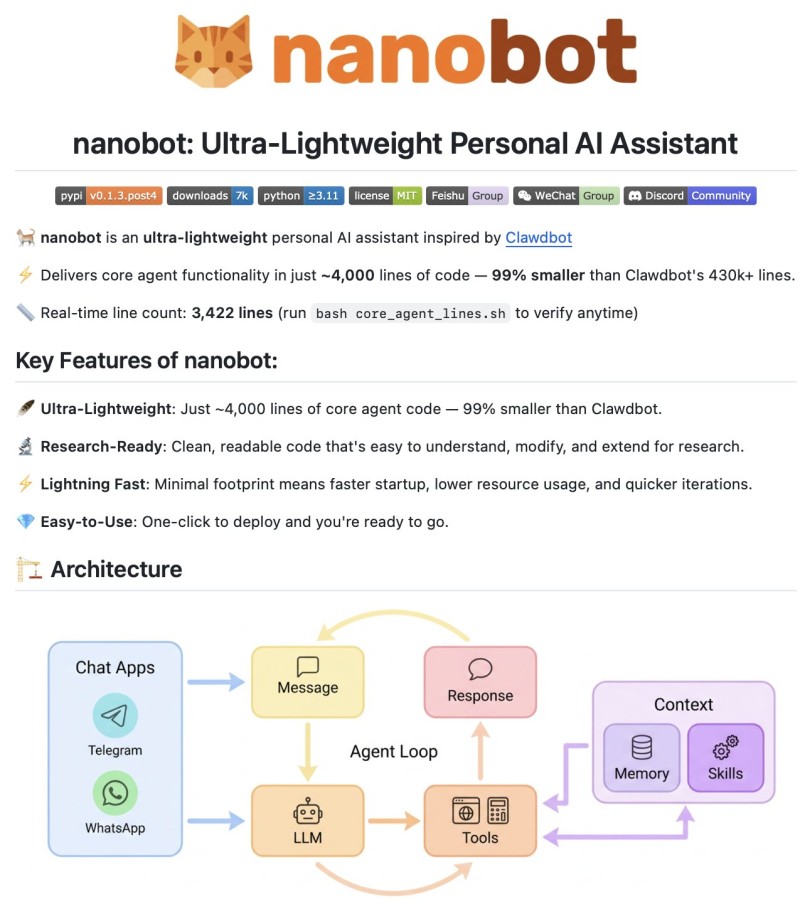
The system packs essential features into this compact framework: an agent orchestration loop connecting large language models with tool execution, persistent memory across sessions, and background task handling. It supports subagents and a skills loader for extending capabilities, along with natural-language task scheduling using cron-style or interval-based execution.
Multi-Platform Support and Easy Deployment
Users can communicate with nanobot through Telegram, WhatsApp, Discord, and Feishu without requiring a public IP connection. "The architecture is designed to be clean and research-ready, allowing developers to understand, modify, and extend the system easily," according to the project description.
Nanobot works with multiple model providers including OpenRouter, Anthropic, DeepSeek, vLLM, Ollama, and any OpenAI-compatible server. Deployment is simplified through Docker with a one-command setup process, making it accessible even for developers new to AI assistant frameworks.
The release demonstrates that lightweight implementation doesn't mean sacrificing functionality. Nanobot maintains core assistant features such as memory, tools, and background execution while significantly reducing overall code complexity, potentially opening the door for more developers to build and customize their own AI assistants.
 Usman Salis



