
 Marina Lyubimova
The artificial intelligence boom is running into a hard wall—not of technology, but of electricity and water. After months of steady growth, data center projects are being shelved at unprecedented rates as utilities struggle to keep pace with demand.
Sharp Spike in Project Cancellations
New infrastructure data reveals mounting pressure on AI expansion. Data center cancellations and postponements jumped to 16 projects in December 2025 after averaging between one and six per month during the prior six months. January 2026 has already reached 25 canceled projects.
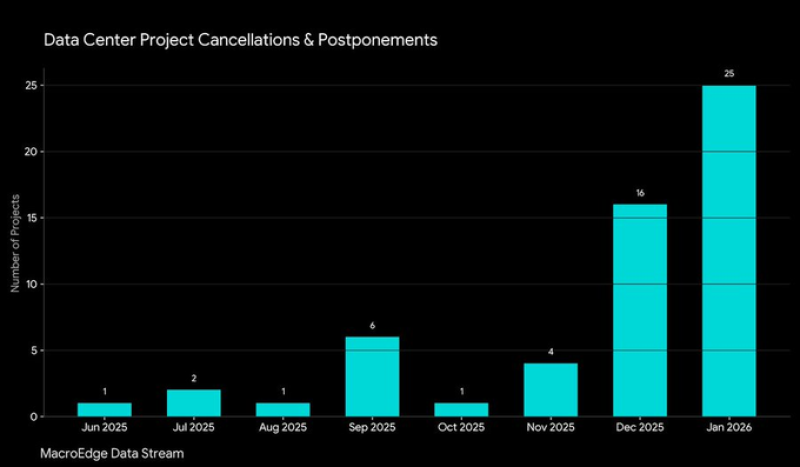
The surge signals a fundamental shift: physical resources, not digital demand, are now the limiting factor.
Water and Power Consumption Reaching Critical Levels
A Meta facility in Newton County, Georgia already accounts for roughly 10% of local water consumption. Industry projections suggest data centers could consume resources equivalent to those used by about 10 million Americans by 2030.
Energy demands tell a similar story. A Louisiana project under construction requires three additional fossil-fueled power plants just to operate. This pressure matches broader trends documented in data center power demand surge, which could triple to 900 TWh by 2030.
Grid Capacity Falling Behind AI Ambitions
Dominion Energy plans to add 47 gigawatts of data center capacity to a grid capable of supporting roughly 23 gigawatts of peak demand—illustrating a massive supply gap. Utilities are struggling to build infrastructure fast enough to support the global AI compute capacity expansion, which recently hit 15 million H100-equivalent chips.
The developments underscore a reality the tech industry is only beginning to acknowledge: future AI growth depends on power generation, water supply, and industrial construction before digital scaling can continue. Without solving these physical constraints, the AI revolution may stall regardless of computational breakthroughs.
 Marina Lyubimova



