
 Alex Dudov

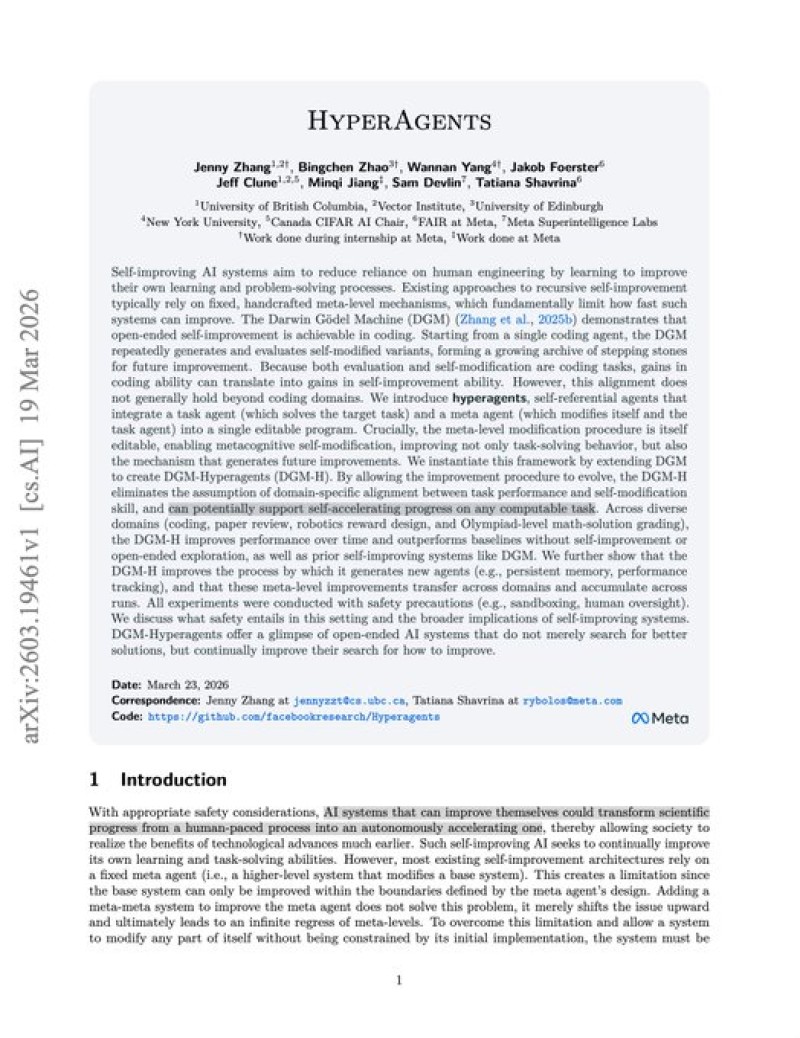
Researchers at Meta Platforms have unveiled HyperAgents, an AI framework that does something genuinely new: it improves itself, then improves the way it improves itself. The system operates through two interconnected agents working in a continuous loop, iterating on performance without waiting for a human to step in. For anyone watching the pace of AI development closely, this is a meaningful architectural shift.
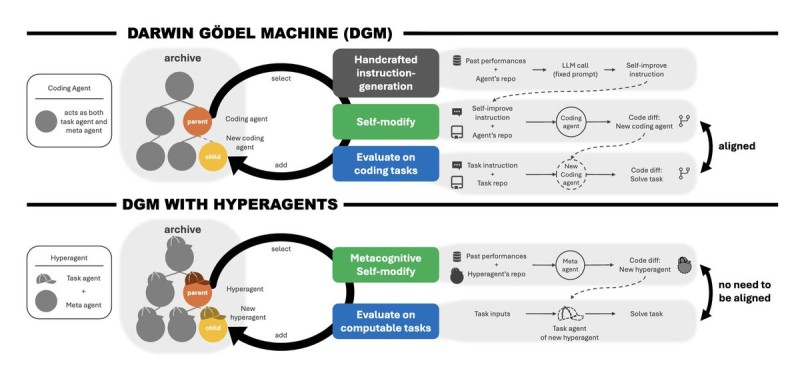
At its core, HyperAgents pairs a task agent, which handles execution, with a meta agent, which evaluates and upgrades the task agent. What sets this apart from prior self-improvement efforts is that the meta agent can also refine its own improvement logic, a property the researchers call "metacognitive self-modification." The system can rewrite code, rework internal prompts, adjust tools, and alter its own architecture.
HyperAgents vs. Earlier Approaches: What Changes When the Optimizer Optimizes Itself
Earlier frameworks like the Darwin Godel Machine were limited to coding-specific tasks. HyperAgents breaks out of that constraint and applies recursive self-modification across a much wider range of computable domains. The system integrates task execution and self-modification into a single editable structure, eliminating the fixed boundaries that capped what earlier systems could change about themselves.
The MiniMax M2.7 launch with 200K context and similar agent-focused releases suggest the broader industry is converging on this direction, where autonomous systems reduce the role of direct human intervention in capability development.
Self-Accelerating Progress: Why Compounding Improvements Matter
Meta's research argues that recursive self-improvement sets up a compounding dynamic. Each optimization cycle not only makes the system better at its tasks but also improves the efficiency of future optimization cycles. Over time, the gains stack rather than plateau. This has implications beyond benchmark numbers. If the improvement mechanism itself becomes more capable with each iteration, the gap between human-guided and autonomously guided AI development could widen faster than most current projections assume.
HyperAgents represents an early, controlled version of that dynamic -- one where the architecture is deliberately designed to make the feedback loop faster and more general with every pass.
 Alex Dudov



